Thursday, 12 June 2025

Technical Mission of the Climate Smart Irrigated Agriculture Project commences

Dr.  Salau reviews the project progress 

Dr. Sheu Salau , Senior Agriculture Economist and Task Team Leader (TTL) for Climate Smart Irrigated Agriculture Project (CSIAP) and his World Bank team arrived in the Project Management Unit this morning to commence the Technical Mission of the CSIAP. The primary objective of this mission is to assess the progress of the project's implementation. Additionally, the mission will: (i) review the status of committed funds and determine if partial cancellation is necessary; (ii) evaluate the readiness to conclude all activities by December 31, 2025; (iii) engage with sector authorities in ongoing policy discussions and World Bank analytics; and (iv) participate in the PROGREEN consultation event focused on landscape governance. 

Multidisciplinary World Bank Team Supports Final Phase Assessment
The mission team included Eng. (Ms) Thiruni Liyanage, Co-TTL and Senior Water Resources Management Specialist, Dr. Athula Senaratne, Senior Agriculture Specialist, Mr. Seenithamby Manoharan, Senior Consultant for  Agriculture and Rural Development, Mr. Jagath Seneviratne, Consultant for  Monitoring & Evaluation and Mr. Sanjeewa Rodrigo, Consultant for Agribusiness & Marketing.

High-Level Consultations Planned with National and Provincial Stakeholders
During this period, the team intends to meet with relevant staff from the Ministry of Agriculture, Livestock, Lands, and Irrigation; Department of Agriculture; Department of Agrarian Development; Department of External Resources; National Planning Department; Chief Secretaries of the North Central, North Western, Northern, Eastern, Southern, and Uva Provincial Councils; Project Management Unit; and six provincial Deputy Project Directors (DPDs).

Field Assessments and Beneficiary Engagement to Validate Project Impact
The team will also conduct field visits to selected CSIAP project sites to assess on-ground implementation, interact with beneficiaries, and gather feedback on project outcomes. This mission is a key milestone in ensuring that CSIAP delivers its intended impact and aligns with national development goals and climate resilience strategies. The PMU team, comprising Provincial Deputy Project Directors, Subject Specialists, and Officers, was led by Mr. K.V. Athula, Deputy Project Director of the PMU, during this meeting.

Wednesday, 11 June 2025

The CSIAP Safeguard Progress Report – May 2025 (Phase II) Submitted to the WB

We are pleased to announce that the May 2025 Monthly Safeguard Progress Report for the Climate Smart Irrigated Agriculture Project (CSIAP) – Phase II has been successfully submitted to the World Bank, in accordance with the Agreed Actions from the last World Bank Mission (April 1–10, 2025).

This comprehensive report outlines key updates on environmental and social safeguard compliance and monitoring efforts across the project’s implementation areas. It reaffirms our continued commitment to: Sustainable irrigation infrastructure development, Livelihood protection, Stakeholder engagement, Biodiversity conservation and Effective grievance redress mechanisms

 Key highlights of the report include:

  • Summary of progress against the 2025 Annual Budget and Work Plan
  • Cumulative update on the implementation of solar-powered, movable, seasonal paddy field protected electric fences
  • Distribution of seed packages to farmers affected by artificial water drawdown
  • Implementation of the Tree Planting Programme
  • Progress on the rehabilitation of 179 tanks and associated Environmental and Social Management Plan (ESMP) activities
  • Updates on ESMP and Grievance Redress Mechanism (GRM) implementation
  • GRM Operations
  • Progress on Agreed Actions from the recent World Bank Mission
  • Identification of safeguard issues and corresponding mitigation measures
  • Publication and media outreach efforts

 The report also includes lessons learned, good practices, and province-wise monitoring summaries from the CSIAP’s target areas, offering valuable insights into the evolving safeguard landscape of the project.

 Access the full report via the link :🔗 Safeguard Progress Report (Phase II - 2025)
 Obtain the relevant annexes here :🔗Annexes – April 2025 Report
 "Please go to the Publications section of the CSIAP website: http://www.csiap.lk/, then navigate to the Safeguard Documents > Other Safeguard Documents, and look for the report listed there." 

Written by Ms. Sharmila Shanmuganthan, Social Safeguard and Gender Development Officer, PMU, CSIAP

Friday, 6 June 2025

Transforming Rural Lives through the CSIAP: The Story of the Kumara Family

Farmer Kumara's Paddy Field
The Climate Smart Irrigated Agriculture Project (CSIAP) in Sri Lanka is a  comprehensive initiative dedicated to improving the productivity and climate resilience of smallholder farmers, especially in provinces most vulnerable to climate change. Through targeted support, technical training, and modern infrastructure, CSIAP has empowered thousands of families to overcome traditional farming challenges and achieve sustainable livelihoods

Background: The Kumara Family’s Challenge
Mr. A. Nishantha Kumara and Ms. S.D. Ayesha Nilangani, a farming couple from Kawanthissapura in the Southern Province, struggled for years with irregular income and poor yields due to inadequate irrigation, unpredictable weather, and limited access to modern agricultural knowledge. Their main concern was ensuring a better future for their two school-going children, particularly through higher education.

 CSIAP Intervention and Support

Kumara and Nilangani are actively engaged in cultivation
Joining the CSIAP program in 2020 marked a turning point for the Kumara family. The project offered a comprehensive set of interventions tailored to their needs, including: technical training on sustainable climate-smart agriculture at the Thirappane Climate Smart Farmer Training School; specialized training on the proper use of fertilizer and leadership development; installation of a sprinkler irrigation system to ensure a reliable year-round water supply; access to high-quality, climate-resilient seeds such as green gram and groundnut; provision of a solar water pump, significantly reducing dependence on electricity for irrigation; an insect-proof net to protect crops from pests; and construction of an agro-well to guarantee continuous water availability. With these resources, the family diversified their cultivation—growing long beans and watermelon on three-quarters of an acre under protected conditions, and paddy on another three-quarters of an acre. The result has been a dramatic increase in both yield and income, with the family now earning a net profit of Rs. 150,000 per month. 

They are with the combined harvester purchased
Impact on Livelihood and Wellbeing
The CSIAP’s interventions have enabled the Kumara family to: cultivate crops throughout the year, regardless of seasonal water shortages, purchase their own combine harvester by eliminating the need to borrow the same machine, support their children’s education, including purchasing a computer for online learning and improve food security, health, and home conditions.
The Kumara family’s journey stands as a testament to the transformative  power of well-designed rural development initiatives. CSIAP’s holistic approach—combining infrastructure, technical training, and ongoing support—has not only improved their economic standing but also restored their dignity and confidence as farmers. 

A Model for Rural Development
The Kumara family’s journey stands as a testament to the transformative power of well-designed rural development initiatives. CSIAP’s holistic approach—combining infrastructure, technical training, and ongoing support—has not only improved their economic standing but also restored their dignity and confidence as farmers.

Nilangani with AF Pathumi

Gratitude and Support
Their gratitude extends to the CSIAP team, whose support was instrumental in their success. They express their sincere thanks to Agriculture Facilitator (AF) Ms. Pathumi Dissanayake for her continuous support and encouragement. They  also acknowledge the valuable guidance and mentorship provided by the Agriculture Instructors, who worked closely with them throughout the process. The Kumara family now serves as an inspiration to neighboring farmers, demonstrating that with the right support, climate-smart agriculture can uplift entire communities and secure a sustainable future for rural Sri Lanka. 

“Thanks to CSIAP, our lives have changed. We can now provide for our children’s future and help others in our community do the same.” — Kumara family 

The Kumara family’s story encapsulates the broader impact of CSIAP: empowering rural families, enhancing climate resilience, and fostering sustainable agricultural practices that benefit both people and the environment. Their story mirrors those of other CSIAP beneficiaries across Sri Lanka, where the project has rehabilitated hundreds of tanks, introduced modern irrigation systems, and provided training and material support to thousands of farmers. These efforts have allowed families to cultivate more land, diversify crops, and consistently improve their incomes.

 Story and photographs by Pathumi Dissanayake,  Agriculture Facilitator, SP, CSIAP

Investing in Nature-Based Solutions: CSIAP’s Path to Climate Resilience

Is CSIAP investing in Nature-Based Solutions to build sustainable climate resilience and enhance ecosystems?
Yes. The World Bank–financed Climate Smart Irrigated Agriculture Project (CSIAP), implemented by Sri Lanka’s Ministry of Agriculture, Livestock, Lands, and Irrigation (2019–2025), actively applies Nature-Based Solutions (NbS) using a Village Tank Cascade System approach. This strategy strengthens climate resilience, restores ecosystems, and improves climate-smart agriculture in vulnerable hotspot areas across 11 districts in six provinces.

1.Understanding Nature-Based Solutions in CSIAP
Nature-Based Solutions are actions that protect, manage, and restore ecosystems while addressing societal challenges such as climate change, food security, and biodiversity loss. CSIAP’s adoption of NbS directly supports Sustainable Development Goal 13 (Climate Action) and aligns with Sri Lanka’s national climate commitments, including greenhouse gas reduction and sustainable development goals.

2.CSIAP’s Key Components Supporting NbS
CSIAP works through four integrated components:

  • Agricultural Production and Marketing: Improves farm productivity, strengthens value chains, enhances market access, and builds the capacity of farmer organizations to ensure sustainable livelihoods and food security.
  • Water Management through Cascade Systems: Rehabilitates and modernizes irrigation systems, promotes water-efficient technologies, and develops water harvesting and storage to ensure year-round water availability.
  • Project Management: Establishes strong institutional, financial, procurement, environmental, and social safeguard systems to ensure coordinated and accountable implementation.
  • Contingent Emergency Response: Enables rapid reallocation of resources to respond to climate shocks, floods, droughts, and other agricultural emergencies.
  • Together, these components create a holistic, adaptive framework for climate-smart agriculture.
3.Major Nature-Based Interventions Under the CSIAP 
3.1 Climate-Smart Agriculture Practices
The CSIAP promotes sustainable, nature-positive farming practices, including:
  •  Micro-irrigation (drip, sprinkler, micro-jet, rainhouse irrigation systems), crop diversification (green gram, cowpea, groundnut, black gram, paddy, chili, onion), inter-seasonal cultivation (green gram, cowpea, black gram), agronomic interventions (agro wells, solar water pumps, highland seeders, weeders, transplanters, poly tunnels, poly mulch, insect-proof nets, and mini tillers), climate-smart seed production, and climate-smart home garden development. A total of 44,155 farmers have adopted at least one improved Climate-Smart Agriculture (CSA) practice, demonstrating widespread uptake across project areas.
  • Regenerative agriculture, such as crop rotation, cover cropping, and minimum tillage, to improve soil health.
  • Erosion control through vegetation cover and conservation bunds.
  • Use of compost and biochar to enhance soil fertility and sequester carbon.

3. 2 Tree-Based and Forest Interventions
The CSIAP recognises forests as critical for climate resilience through 

  • Community-led reforestation and preschool-based tree planting programmes.
  • Agroforestry and climate-smart home gardens that improve biodiversity and farm productivity.
  • Catchment protection measures, such as the establishment of tree belts (e.g., Kattakaduwa-type green belts), to conserve water resources and restore degraded landscapes.
 3.3 Green and Climate-Smart Infrastructure
The CSIAP promotes environmentally sensitive infrastructure development, including:

  •  Climate-smart farmer training schools (such as Thirappane) with eco-friendly designs and green concepts, where over 2,946 lead farmers (including 1,221 women) were trained between 2023 and 2025. 
  • Rehabilitation of village tank systems to restore natural water flows: 457 tanks completed in 2024 and 185 ongoing in 2025. Following baseline surveys, participatory rural appraisal, hydrological studies, engineering surveys, and hotspot area agriculture development plans, designs and estimates were prepared to rehabilitate the village tanks using the cascade-based approach.
  • Design of infrastructure based on environmental and social safeguards to ensure long-term sustainability of cascade systems.
3.4 Integrated Biodiversity and Ecosystem Protection
The CSIAP integrates biodiversity conservation by:
  • Establishing over 1,000 solar-powered movable electric fences to reduce human–wildlife conflict in multiple districts.
  • Restoring catchments through tree planting, biodiversity-friendly land use, and bund construction. 
  • Protecting wildlife corridors while improving crop security and farmer safety.
4. Integrated Water Resources Management (IWRM) Under the CSIAP
The CSIAP applies robust IWRM strategies, including:
  • Integration of environmental safeguards into all physical works.
  • Improvement of water quality through over 183 km of drainage canal rehabilitation and pollution control.
  • Watershed management through village tank rehabilitation across 15 river basins.
  • Restoration of over 1,500 agro-wells to promote sustainable groundwater use.
  • Construction of saltwater intrusion control structures, including a 500-meter bund in Semmankuntru, Kilinochchi.
  • Formation of 60 Cascade Management Committees and development of cascade-level water management plans to strengthen local governance.
  • Capacity building, community mobilization, and participatory planning to empower local stakeholders.
 5.Sri Lanka’s Climate Commitments and CSIAP’s Contribution
Sri Lanka has committed to:

  • Reducing greenhouse gas emissions by 14.5% by 2030.
  • Generating 70% of electricity from renewable sources by 2030.
  • Achieving carbon neutrality by 2050.
The CSIAP contributes to these national targets by:
  • Enhancing carbon sequestration through tree planting and improved soil management.
  • Reducing dependence on fossil fuel–intensive agricultural inputs.
  • Strengthening climate-resilient rural livelihoods and green job opportunities.
 6. Outcomes and Case Study Highlights
The CSIAP’s NbS approach has delivered multiple co-benefits:
  • 44, 155 people with enhanced resilience to climate risks (Number of people) CRI (The number of people adopted CSA practices can be reasonable assumed to have enhance resilience to climate risks.
  • 6,976 people with enhanced resilience to climate risks – Youth (Number of people).
  • 19,428 people with enhanced resilience to climate risks – Female (Number of people).
  • 66,039 people with strengthened food and nutrition security (Number of people).
  • 10,434 people with strengthened food and nutrition security – Youth (Number of people).
  • 29,057 people with strengthened food and nutrition security – Female (Number of people).
  • 4,120 Ha terrestrial and aquatic areas under enhanced conservation and management (Hectare (Ha)).
  • Climate change mitigation through carbon sequestration.
  • Economic growth via green job creation in agroforestry and land restoration.
  • Biodiversity recovery through ecosystem-based planning and habitat restoration.
 7.Challenges and Moving Forward
Despite strong progress, CSIAP faces challenges, including:
  • The need for stronger multi-stakeholder coordination.
  • Limited monitoring and reporting mechanisms.
  • Technical capacity gaps at grassroots levels.
  • Funding constraints for long-term sustainability.

To address these, it is recommended to strengthen policy frameworks, promote public–private partnerships, empower communities through participatory approaches, and expand rational monitoring systems.

Conclusion
Nature-Based Solutions provide a cost-effective, scalable pathway for building climate resilience and restoring ecosystems. CSIAP demonstrates how integrated water management, climate-smart agriculture, and biodiversity conservation can work together to deliver sustainable development outcomes. As climate risks intensify, scaling up NbS-inspired initiatives will be critical for Sri Lanka and other climate-vulnerable countries.

By Sharmila Shanmuganathan, Social Safeguard and Gender Development Officer, PMU, CSIAP  

Saturday, 31 May 2025

The Inspiring Story of Mr. W. G. Nandadewa and Family in Climate Smart Farming

Farming is a hardworking industry where dedication and commitment often yield amazing outcomes. In agriculture, age is not a limitation—intention and perseverance matter most. This is clearly seen in the story of senior farmer Mr. W. G. Nandadewa, aged 60, who continues to work tirelessly in the agricultural sector with the same vigour as a young farmer.

 A Family United by Agriculture
Mr. Nandadewa, based in Ranawarnawa under the Weeravila Agrarian Centre Division, is a shining example of lifelong commitment to farming. His wife, Mrs. M. Karunawathi (age 58), provides unwavering support and courage, managing her own climate-smart home garden with assistance from the Climate Smart Irrigation Agriculture Project (CSIAP). Their shared passion for agriculture has inspired their son, Mr. W. G. Dinesh Chathuranga (age 33), who has also embraced farming under his father’s guidance.

AF Ms. Nuwanthi exchanges ideas with the farmer
 Embracing Sustainable Farming Practices
Over many years, Mr. Nandadewa’s hard work and dedication have made him a highly experienced farmer. Recently, CSIAP provided him with a compost kit to produce organic compost fertiliser for his cultivation. Alongside the kit, he received specialised training in compost fertiliser production, enabling him to reduce his reliance on chemical fertilisers. Currently, Mr. Nandadewa cultivates pumpkins on half an acre of land using his own compost fertiliser. This sustainable approach not only benefits his crops but also sets a positive example for other farmers in the community. He is eagerly anticipating his maiden harvest, confident in the fruits of his labour.

Mentorship and Support
Mr. Nandadewa’s success is also attributed to the valuable guidance and mentorship from Mr. H. J. A. Malaka, Agriculture Instructor at Mattala, who has worked closely with him. He expresses deep gratitude to Agriculture Facilitator (AF) Ms. K. A. A. Nuwanthi and the entire CSIAP team for their continuous support and encouragement throughout his farming journey.

Story and photographs by K.A.A. Nuwanthi, Agriculture Facilitator, SP, CSIAP

Friday, 30 May 2025

Empowering Youth in Agriculture: The Story of Dinesh’s Long Bean Cultivation

The Climate Smart Irrigation Agriculture Project (CSIAP) is consistently committed to promoting and supporting young farmers across its project areas. As part of this mission, the CSIAP makes every effort to identify passionate and determined individuals who are eager to embrace modern, climate-smart cultivation practices. In the Southern Province, the Deputy Project Director’s Office of CSIAP identified one such individual: Mr. W.G. Dinesh Chathuranga, a dynamic 33-year-old farmer from Ranawarana, within the Weerawila Agrarian Service Centre Division. Dinesh was inspired to pursue farming by his father, Mr. W.G. Nandadewa, who is also a beneficiary of the CSIAP. 

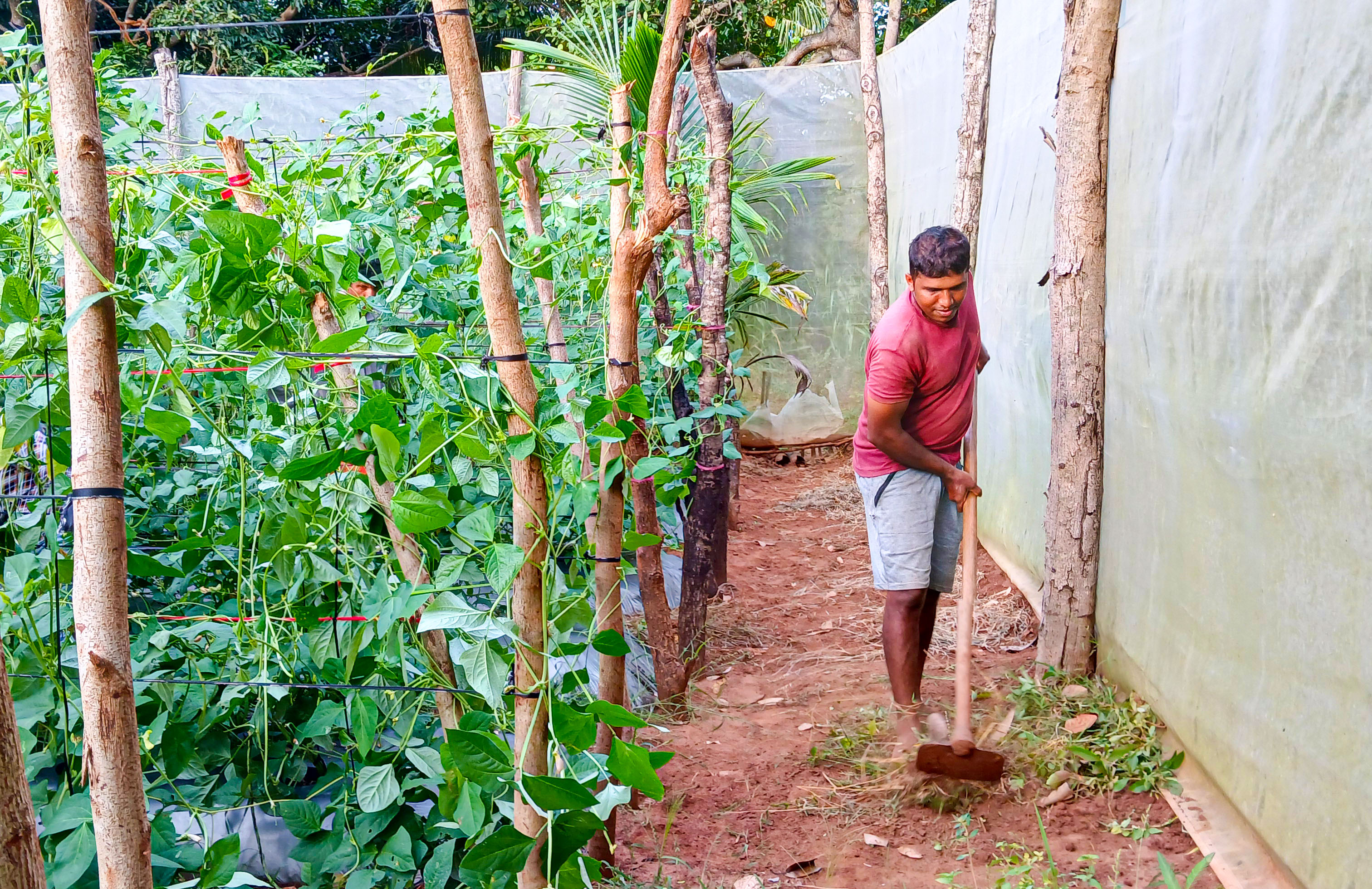
Cleaning up weeds
 A Journey of Dedication and Learning
Dinesh’s strong commitment and determination have set him on the path to becoming a successful farmer. His current long bean (Mea) cultivation stands as a testament to his perseverance and passion, especially as this marks his first experience as a young farmer. He was first identified through a CSIAP awareness programme conducted in his area. Recognising his potential, the project enrolled him in a three-day residential training at the Climate Smart Farmer Training School in Thirappane, where he gained in-depth knowledge of climate-smart agricultural practices and technologies. To further build his capacity, Dinesh also received specialised training in compost fertiliser production, which enhanced his ability to maintain sustainable and eco-friendly cultivation practices. 

Support from Mentors and the CSIAP Team
The farmer was being guided by AF Ms. Nuwanthi 
Dinesh benefited greatly from the guidance and mentorship provided by Mr. H.J.A. Malaka, Agriculture Instructor at Mattala, who worked closely with him. Through the Farmer Business School programme conducted by Mr. Malaka, Dinesh was trained to approach his cultivation not just as a livelihood but as a viable business opportunity. 
In addition, Dinesh expresses deep gratitude to Agriculture Facilitator Ms. K.A.A. Nuwanthi and the wider CSIAP team for their ongoing support and encouragement throughout his journey.

Resources for Success
To ensure the success of his cultivation, CSIAP provided Dinesh with key agricultural inputs, including an insect-proof net and a drip irrigation system. With these resources, he successfully cultivated long beans on a quarter-acre plot of land.

Looking ahead
Dinesh is now eagerly awaiting his maiden harvest, a milestone that marks the beginning of a promising future in agriculture. The CSIAP extends its best wishes to Dinesh as he continues to grow as a climate-smart farmer and entrepreneur. His journey is an inspiring example for other young people to follow, proving that with the right support, training, and determination, success in farming is not only possible but rewarding.

 Story and photographs by K.A.A. Nuwanthi, Agriculture Facilitator, SP, CSIAP

Thursday, 29 May 2025

The success of farmer Prabash: from struggle to sustainability through the CSIAP

 The Climate Smart Agriculture Project (CSIAP) is committed to transforming young farmers into successful agripreneurs by offering technical and infrastructural support. One inspiring example is Mr. H. A. Prabash Kumara, a 41-year-old farmer from Bathalaara village, located in the Nugayaya Grama Niladhari Division under the Wellawaya Agrarian Service Centre Division. Thanks to his determination and the strategic support from the CSIAP, Mr. Prabash has transformed his farming life and now serves as a role model for others in his community.

Farmer Mr. Prabash Kumara
 Before CSIAP: Struggles with Water and Profitability
“Before CSIAP, I struggled to cultivate my five acres of land,” recalls Prabash. “The biggest issue was water scarcity, and I made barely enough to cover labour costs, with no real profit.”

 Turning Point with the CSIAP Support
Everything changed when the Deputy Project Director’s Office of the CSIAP in Uva Province intervened. The project team identified Prabash’s needs and provided critical support: an agro-well to address chronic water shortages, a sprinkler irrigation system for his turmeric cultivation and an insect-proof net to protect his chilli crops. “These interventions were a real boost for me to move forward,” he says. With improved water access and crop protection, Prabash began cultivating: 1.5 acres of paddy, 3.5 acres of intercropped fields with pumpkin, mango, orange, gotukola, gherkin, tomato, and banana and long-term crops like guava and coconut. He proudly uses only rainwater and the agro-well water for his farming needs and even supplies water to five neighbouring families to help them continue their cultivation.

Managing his livestock
Sustainable Farming and Community Impact
Prabash has embraced Integrated Pest Management (IPM) by using sticky containers to reduce insect damage, avoiding harmful chemicals and promoting healthier produce. He has also established his own plant nursery to meet the seedling demands of his crops. Transportation and sales of his produce are handled by himself, ensuring better market access and profit margins. With his thriving farm, he now provides employment to 12 individuals from Sinhala, Tamil, and Muslim communities, promoting social cohesion and inclusive development. In addition to crop farming, Prabash raises 15 goats and a donkey, using their droppings to produce compost fertiliser, which now makes up 50% of his fertilisation needs. He plans to expand his operations further with polytunnel cultivation, which will create more employment opportunities.

Farmer Mr. Prabash with AF Ms. Kasurika

Gratitude and Recognition
Prabash expresses his deep gratitude to the CSIAP, especially to Ms. W. M. Kasurika, Agriculture Facilitator in Wellawaya, for her unwavering guidance and support throughout his farming journey. He also extends his sincere thanks to Mr. D.V.C. Nishans, former Agriculture Instructor in the Wellawaya area and Mr. D. M. Sashika Priyankara, present Agriculture Instructor, whose technical expertise and dedicated assistance played a crucial role in the successful cultivation of his crops. The combined support and encouragement from three officers have been instrumental in his transformation into a successful agripreneur.

Today, Prabash earns a net profit of Rs. 200,000 per month, a remarkable turnaround from his earlier struggles. His journey is a testament to how targeted support, sustainable practices, and personal determination can change lives and uplift communities.

Farmer Mr. Prabash Kumara spoke with heartfelt gratitude, emphasizing how the CSIAP had transformed his life. “Thanks to CSIAP, my life has turned around, and now I help others grow with me,” he said, reflecting a deep sense of purpose and commitment to his community.

Photographs by Nuwan Dileepa, Monitoring and Evaluation Officer, SP&UP, CSIAP
Story by Samantha Mallawaarachchi, IEC&ICT Specialist, PMU, CSIAP