Monday, 7 April 2025

The World Bank Officials arrived in NCP to review the progress of the CSIAP

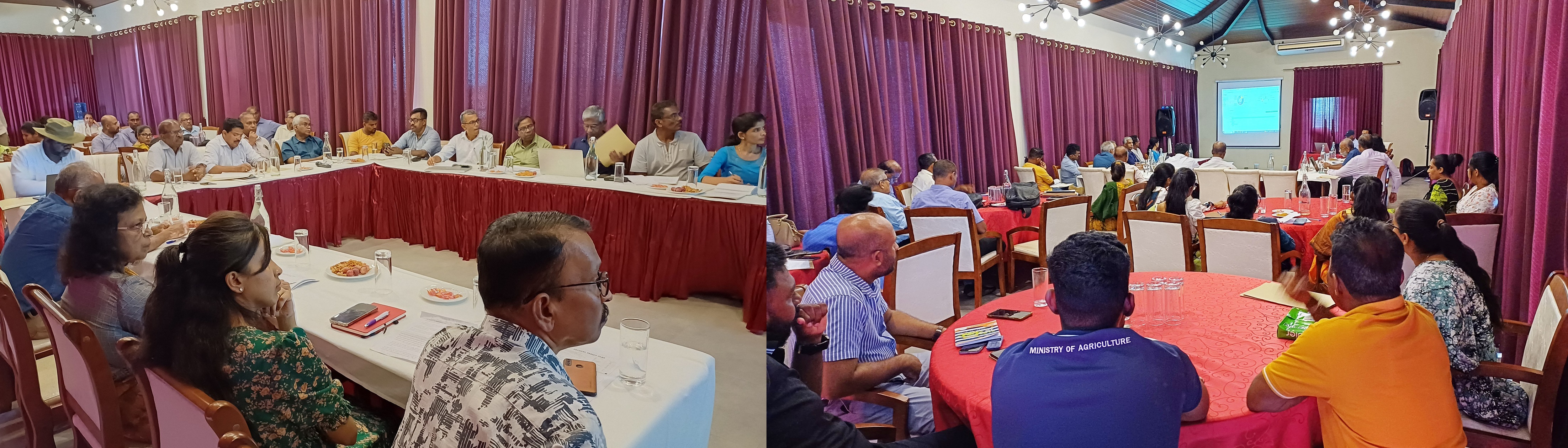
The World Bank Team of the 14th Implementation Support and Review Mission of the Climate Smart Irrigated Agriculture Project (CSIAP) arrived in North Central Province today (07th) to ensure that the project is being implemented effectively, in accordance with the agreed-upon plans, and is on track to achieve its development goals of the CSIAP. The progress review meeting of the province commenced at Sooriya Wessagiri Resort, Anuradhapura, this afternoon.

The World Bank’s supervision is critical for maintaining accountability, enhancing transparency, and ensuring the effectiveness of the CSIAP. Representing the World Bank, Dr. Sheu Salau (Senior Agriculture Economist/Task Team Leader (TTL) for the CSIAP), Ms. Thiruni Liyanage (Co-TTL /Water Resources Management Specialist), Dr. Athula Senaratne (Senior Agriculture Specialist), Mr. Seenithamby Manoharan (Senior Consultant for Agriculture and Rural Development) and Jagath Seneviratne (Consultant for Monitoring & Evaluation) joined the mission. 

The progress of the CSIAP’s activities in North Central Province was presented through Management Information Systems (MIS) by Subject Specialists in front of the World Bank team.  Mr. Saman Bandulasena, Project Director and Subject Specialists and Officers of the Project Management Unit were also present at this meeting. Ms. Madushani Gunathilake, PhD Researcher at the Adam Smith Business School, University of Glasgow, UK and Senior Lecturer of the Faculty of Management, University of Peradeniya also participated. Mr. R.P.M. Dissanayake, Deputy Project Director of the CSIAP in North Central Province guided and facilitated this World Bank Mission in North Central Province with his staff.

The CSIAP farmers from Northern Province warmly welcome World Bank officials

The World Bank Officials of the  14th Implementation Support Mission of the CSIAP, visiting areas where the CSIAP is being executed,d were warmly welcomed by the CSIAP’s beneficiary farmers in Northern Province.  This mission is designed to ensure that pthe roject is progressing as planned, identify challenges, and provide technical assistance where necessary. Dr. Sheu Salau (Senior Agriculture Economist/Task Team Leader (TTL) for the CSIAP), Ms. Thiruni Liyanage (Co-TTL /Water Resources Management Specialist), Dr. Athula Senaratne (Senior Agriculture Specialist), Ms. Saumya Srivastava (Agriculture Specialist and CSIAP ICR Author), Mr. Seenithamby Manoharan (Senior Consultant for Agriculture and Rural Development), Jagath Seneviratne (Consultant for Monitoring & Evaluation) and Mr. Sanjiva Rodrigo (Consultant for Value Chain and Agribusiness) of the World Bank joined the mission. 

 Here's a breakdown of what it typically involves:

  • Monitor project progress: Assess whether the project is on track with timeline, budget, and outcomes.
  • Identify and resolve problems: Detect any issues early on in terms of environmental/social safeguards. and work with the client to resolve them.
  • Ensure compliance: Verify that the project complies with World Bank policies (such as financial management, procurement, environmental and social safeguards etc.).
  • Strengthen capacity: Provide technical assistance or training to the implementing agencies when needed.
  • Document findings: The mission usually produces an Aide-Memoire summarising findings, recommendations, and agreed-upon next steps, followed by a Management Letter if necessary.

Typical Activities During a Mission 

  • Field visits to project sites
  • Meetings with implementing agencies and beneficiaries
  • Review of financial records and procurement documentation
  • Discussions on risks and mitigation strategies
The World Bank Officials number of sites in Kilinochchi to observe the CSIAP progress as follows.

The CSIAP support for Farmers in Kilinochchi to boost Paddy Cultivation with Modern Equipment.As part of ongoing efforts to strengthen paddy cultivation in the Kilinochchi District, three paddy transplanters, three power weeders, transplanting trays, and quality paddy seeds have been provided to Union Viluthukal Young Farmers Club, Konawil, Kilinochchi. This initiative is aimed at improving agricultural efficiency and productivity during both the Yala and Maha seasons. The support also includes guidance and resources for maintaining transplanting nurseries, ensuring that farmers are equipped with the knowledge and tools needed to adopt modern and sustainable farming practices. These interventions are expected to significantly reduce labour costs, improve crop yield, and promote timely transplanting in the district.

The CSIAP completed rehabilitation works of the Kudithankiyakulam tank in Oddusuddan, covering a total command area of 54 acres and handed it over to farmers. This programme aimed at improving water resource management and community infrastructure. The scope of work included the construction of a bund, bathing steps, sluices, water channels, and access roads. These efforts are part of a broader initiative to enhance irrigation efficiency, ensure a reliable water supply, and improve accessibility for local communities. The project is expected to significantly contribute to sustainable agricultural practices and community well-being. The World Bank team met and exchanged views with farmers in the area.

The CSIAP offered laser levelling facilities to farmer Mr.  N. Sivaskaran (age 49) to use in his paddy field in Oddusuddan. Laser levelling in paddy fields is a modern agricultural technique used to precisely level the land using a laser-guided system. It’s especially beneficial for rice cultivation, in which uniform water distribution and field conditions are crucial. Laser levelling uses a laser transmitter, a receiver mounted on a levelling blade, and a tractor to ensure that the entire field is levelled within a few centimetres of accuracy. The system adjusts the blade height in real-time based on the laser signals. Benefits of Laser Leveling in Paddy Fields are Uniform Water Distribution, Water Saving, Better Crop Establishment, Improved Fertilizer Efficiency, Higher Yields and Reduced Labor &Time. An Alternate Wetting and Drying (AWD) method was installed in farmer Mr. N. Sivaskaran’s paddy field. AWD installation alongside laser levelling, that's a powerful combo for rice cultivation.

To mark the commencement of the Karuvelankandalkulam downstream works, a commemorative plaque was unveiled by Dr. Sheu Salau. Both World Bank officials were warmly welcomed and escorted to the worksite with a traditional pageant. The World Bank team, along with senior officials from the CSIAP, the implementing agency, and local farmers, ceremoniously laid the foundation stones. The downstream construction will include two sluices, a 1,200-meter-long water channel, and a siphon—key components designed to enhance water flow management and ensure efficient downstream conveyance.

In a positive development for agricultural land in Oddusuddan, 69-year-old farmer Mr. V. Rubanathan has successfully cultivated watermelon and bitter gourd. This success is largely attributed to the use of high-quality seed varieties and an efficient sprinkler irrigation system provided by the project. The combination of premium seeds and modern watering techniques has resulted in improved crop yields, healthier plants, and more sustainable farming practices. Additionally, effective water flow management has ensured efficient conveyance downstream, further supporting the overall productivity of the land.

A 2.5 km long solar-powered electric elephant fence has been successfully erected in Thattaya Malai and Perisalamban - a major stride in mitigating human-elephant conflict (HEC). This eco-friendly initiative now protects 600 acres of farmland and directly benefits over 2,000 families across four Divisional Secretariat Divisions. More than just a barrier, this solar-powered system safeguards both lives and livelihoods while fostering peaceful coexistence between humans and elephants. It stands as a powerful example of community-led conservation and sustainable living, paving the way for a safer, greener future for all.

Mr. Ananda Ruban, a 45-year-old farmer, was provided with several agricultural inputs to support successful year-round cultivation. These included an Insect-Proof Net, Agro Well, Sprinkler System, Inter-Cultivator, and Roller Seeder. To further enhance productivity and promote sustainable farming practices, high-quality seeds of Groundnut, Chilli, Watermelon, Capsicum, and Onion, along with Onion Bulbs, were also distributed.

Mr. S.M. Saman Bandulasena, Project Director, along with specialists from the Project Management Unit, were also present. The World Bank Mission was organized and facilitated by Mr. George Babu, Deputy Project Director of the CSIAP in the Northern Province, with the support of his provincial staff.

By Samantha Mallawaarachchi, IEC & ICT Specialist, PMU, CSIAP

Sunday, 6 April 2025

Dr. Sheu Salau Receives a Token of Appreciation from the DPD - CSIAP in NP

Dr. Sheu Salau, Senior Agriculture Economist and Task Team Leader (TTL) for the Climate Smart Irrigated Agriculture Project (CSIAP), was honoured with a token of appreciation by Mr. George Babu, Deputy Project Director of the CSIAP in the Northern Province, during the 14th Implementation Support Mission of the CSIAP. 

This gesture reflects the profound gratitude of the CSIAP team for Dr. Salau’s exceptional leadership, steadfast support, and invaluable contributions to the project’s progress. His guidance has been instrumental in steering CSIAP toward its development objectives with dedication and strategic vision.

Dr. Salau’s leadership has not only ensured effective coordination and oversight but has also inspired the project team to pursue excellence at every stage. The CSIAP deeply values his commitment and the collaborative spirit he consistently brings to the partnership. The CSIAP extends its heartfelt thanks for his ongoing support, which continues to enhance the impact and effectiveness of the project on the ground. 

CSIAP Farmers in NP Demonstrate the Power of Walk-Behind Paddy Transplanters


The CSIAP beneficiary farmers from the Union Viluthukal Young Farmers Club in Konavil, Kilinochchi, demonstrated the capabilities of walk-behind paddy transplanters in front of World Bank Officials who are on the 14th Implementation Support Mission of the CSIAP in Northern Province. The walk-behind paddy transplanter is designed for transplanting rice seedlings into a puddled and levelled field. It is recommended for small to medium-sized farms. This requires less time than manual transplanting and minimises the drudgery and cost of rice transplanting. Additionally, it ensures higher crop productivity, optimal plant spacing, and a greater number of seedlings per hill. Moreover, it uses less labour and ensures timely planting, requires less time than manual transplanting, minimises the drudgery and cost of rice transplanting, ensures higher crop productivity and provides optimum plant spacing and number of seedlings per hill. The CSIAP provided Unionviluthukal Young Club with three walk-behind paddy transplanters, three power weeders, transplanting trays, and paddy seeds. Transplanters are used in 40 acres of paddy fields in both the Yala and Maha seasons. The machines given are used,  and transplanting nurseries are maintained under the guidance and supervision of Mr. S Diriyan, Agriculture Instructor in  Akkarayakulam.

The nursery bed is a crucial component when using a walk-behind paddy transplanter, and its necessity lies in ensuring that the seedlings are grown in a way that matches the machine’s requirements. Here's a breakdown of why it’s needed:

1. Uniform Seedling Growth: The machine requires uniform seedlings (same height, density, and maturity) to operate efficiently, and a well-managed nursery ensures consistent growth, which is key for smooth transplanting.

2. Mat-Type Seedlings: Walk-behind rice transplanters typically use mat-type seedlings grown on flat nursery beds (often on plastic sheets or trays), and the machine lifts and cuts these mats into rows and plants them – random seedlings won’t work.

3. Proper Root Structure: Nursery beds are designed to encourage dense, shallow root systems that hold together well in a mat, and this is essential for the mechanical fingers of the transplanter to grip and plant the seedlings without breakage.

4. Machine Compatibility: The seedling mats must match the dimensions of the transplanter’s seedling tray, and preparing the nursery bed accordingly ensures the machine operates without jamming or missed planting.

5. Time and Labour Efficiency: A properly prepared nursery ensures faster and more accurate planting, saving time and labour compared to manual transplanting, and poor nursery prep = machine downtime and manual corrections = lost efficiency.

Mr. S.M. Saman Bandulasena, Project Director and Specialists from the Project Management Unit, were also present. Mr. George Babu, Deputy Project Director of the CSIAP in Northern Province, organized and facilitated this World Bank Mission with his provincial staff.

The World Bank Officials arrived in NP to review the progress of the CSIAP

The World Bank Team led by Dr. Sheu Salau (Senior Agriculture Economist/Task Team Leader (TTL) for the CSIAP) of the 14th Implementation Support and Review Mission of the Climate Smart Irrigated Agriculture Project (CSIAP) arrived in Northern Province today (06th) to assess the current implementation status and evaluate the achievements against the project development objectives of the CSIAPs progress in Northern Province. The progress review meeting commenced at the CSIAP's Provincial Deputy Director's Office in Kilinochchi, this afternoon.

Representing the World Bank, Ms. Thiruni Liyanage (Co-TTL /Water Resources Management Specialist), Dr. Athula Senaratne (Senior Agriculture Specialist), Mr. Seenithamby Manoharan (Senior Consultant, Agriculture and Rural Development)
and Jagath Seneviratne (Monitoring & Evaluation Consultant) joined the mission. The overall progress of the CSIAPs activities achieved in Northern Province was presented through Management Information Systems (MIS) by Monitoring & Evaluation Officer Mr. M.M.A. Abrar while Subject Officers presented subjective presentations in front of the World Bank team. Mr. Saman Bandulasena, Project Director and Subject Specialists and Officers of the Project Management Unit were also present at this meeting. Mr. George Babu, Deputy Project Director of the CSIAP in Northern Province guided and facilitated this World Bank Mission in Northern Province with his staff.

Saturday, 5 April 2025

Eastern Province CSIAP Farmers Give Heartfelt Welcome to World Bank Delegation

The World Bank Team on the 14th Implementation Support mission was warmly welcomed during the mission by the CSIAP beneficiary farmers in Eastern Province.  The mission is conducted to assess progress on implementation, identify challenges, and provide guidance on necessary corrective measures to ensure the project remains aligned with its objectives and agreed timelines of World Bank-supported CSIAP. The World Bank has been actively conducting an Implementation Support Mission (ISM) every six months to monitor and enhance the effectiveness of the CSIAP. Representing the World Bank, Dr. Sheu Salau (Senior Agriculture Economist/Task Team Leader (TTL) for the CSIAP), Ms. Thiruni Liyanage (Co-TTL /Water Resources Management Specialist), Dr. Athula Senaratne (Senior Agriculture Specialist), Ms. Saumya Srivastava (Agriculture Specialist and CSIAP ICR Author), Mr. Seenithamby Manoharan (Senior Consultant for  Agriculture and Rural Development), Jagath Seneviratne (Consultant for Monitoring & Evaluation) and Mr. Sanjiva Rodrigo (Consultant for Value Chain and Agribusiness) joined the mission. 

Objectives of the Mission: The main objectives of the mission are to:

  • Review the overall progress of the project activities.
  • Assess compliance with financial, procurement, and safeguard policies.
  • Evaluate the effectiveness of institutional arrangements and project management structures.
  • Provide technical assistance and recommendations to address implementation bottlenecks.
  • Strengthen stakeholder engagement and coordination mechanisms.

Activities Undertaken During the Mission: During the mission, the team undertook the following activities:

  • Field visits to selected project sites.
  • Meetings with project staff. implementing agencies, and local stakeholders.
  • Review of project documentation, including procurement records, financial statements, and safeguard reports.
  • Discussions with beneficiaries to gather feedback on project impact and concerns.
The World Bank Officials visited various sites as follows, where benifited from the CSIAP.

Mr. M. Nisanthan, a 29-year-old graduate of the University of Peradeniya, is an active participant in the CSIAP programme in Kuchchaveli, Trincomalee. As part of the project’s support, he received a drip irrigation system, vegetable seeds, and poly mulching materials for his cultivation activities. Mr. Nisanthan successfully completed Climate Smart Agriculture (CSA) training at the Farmer Training School in Thirappane, along with business training at the Farmer Business School in Kuchchaveli. With the knowledge gained and the guidance provided by the project, he now cultivates onions, long beans, and brinjal successfully.

Mr. K. Konesh, a 61-year-old farmer from Kuchchaveli, Trincomalee, received training on Climate-Smart Agriculture (CSA) at the Farmer Training School in Thirappane, along with additional onsite CSA training. As part of the project support, he was provided with a sprinkler irrigation system and seeds—specifically, chilli and brinjal. Ms. U. S. Sameeha, the Agriculture Facilitator in Kuchchaveli, continues to provide Mr. Konesh with the necessary technical guidance and information to support his farming activities.

Dr. Sheu Salau officially unveiled the plaque of the Thuwarankulam Project in Pulmoddai alongside his team. This important initiative marks a significant step in enhancing local irrigation infrastructure.Under the project, eight new turnouts and a 1 km-long water channel will be constructed. Additionally, a new sluice will be built, while the existing tank bund, one sluice, and a spill will undergo essential repairs. As part of the project’s inclusive approach, the World Bank team engaged directly with farmers and members of the Social Audit Committee. 

The World Bank officials received a warm welcome from the farmers in Pulmoddai, who then accompanied them to the Pulmoddai Agrarian Service Centre for a meeting with members of the Kaataru and Puliyankulam Cascade Management Committees.

World Bank officials visited the Seed Paddy Cleaning Unit in Mailawewa, Gomarankadawala, to observe its daily operations. The CSIAP has provided a Paddy Seed Cleaner and a Bag Closer Machine to the Vishaka Producer Society, enabling them to carry out the unit’s day-to-day functions efficiently.

Young farmer Mr. Kasun Nirmal, 24, from Mailawewa, received an insect-proof net, poly mulching materials, and a drip irrigation system through the project. He also underwent onsite training on Climate-Smart Agriculture (CSA) practices. Currently, Kasun cultivates capsicum and chilli using these improved techniques.

Mr. M. Dharmadasa, a 61-year-old farmer from Galgadawa, has significantly enhanced his farming practices through support received under the Climate-Smart Agriculture (CSA) initiative. The project equipped him with solar panels, an agro well, an insect-proof net, poly mulching, and a drip irrigation system—transformative tools for sustainable farming. To build his capacity, Mr. Dharmadasa attended CSA training at the Farmer Training School in Thirappane and the Farmer Business School. Additionally, he benefited from specialised onsite training tailored to CSA techniques. As part of the support package, he also received high-quality seeds, including chilli, capsicum, mung beans, and maize, helping him diversify and strengthen his crop production. Mr. Dharmadasa's journey exemplifies how targeted interventions and training can empower smallholder farmers to adopt resilient, climate-smart agricultural practices.

A 3km long solar-powered electric elephant fence, which covers 60 acres, was given to  Gamunu Farmer Society in Madugahawewa. The solar-powered elephant fence is proving to be an effective and sustainable solution to mitigate human-elephant conflicts, particularly in areas where the CSIAP is being implemented. These fences utilise solar energy, reducing reliance on grid electricity and lowering operational costs. By deterring elephants from entering human settlements, these fences help prevent crop damage and property destruction, while also safeguarding elephants from potential harm due to human retaliation. In Sri Lanka, where human-elephant conflicts are a significant concern, adopting solar-powered fencing solutions could offer a sustainable and humane approach to coexistence.

The alternate wetting and drying (AWD) method, which is a water-saving irrigation technique primarily used in rice cultivation where fields are intermittently flooded and drained, instead of being continuously submerged, was given to the Kudapanikatiyawa Farmer Organisation in  Panikatiyawa. This method allows for significant water savings (up to 30% reduction) without affecting yield. AWD also helps reduce greenhouse gas emissions, particularly methane, from rice production. An AWD was installed in farmer Mr. S. Senevirathna’s paddy field too. 

Mr. S.M. Saman Bandulasena, Project Director and Subject Specialists and Officers from the Project Management Unit, were also present. Mr. R. Umakanthan, Deputy Project Director of the CSIAP in Eastern Province, organized and facilitated this World Bank Mission with his provincial staff.

By Samantha Mallawaarachchi, IEC & ICT Specialist, PMU, CSIAP

Friday, 4 April 2025

The World Bank Officials arrived in EP to review the progress of the CSIAP

Dr. Sheu Salau (Senior Agriculture Economist/Task Team Leader (TTL) for the CSIAP) and his World Bank Team of the 14th Implementation Support and Review Mission of the Climate Smart Irrigated Agriculture Project (CSIAP) arrived in Eastern Province today (04th) to evaluate the implementation and performance of the CSIAP’s progress in Eastern Province. The progress review meeting of the province commenced at the Agrarian Service Center in Uppuveli, Trincomalee, this afternoon.

The World Bank’s supervision is critical for maintaining accountability, enhancing transparency, and ensuring the effectiveness of the CSIAP. Representing the World Bank, Ms. Thiruni Liyanage (Co-TTL /Water Resources Management Specialist), Dr. Athula Senaratne (Senior Agriculture Specialist), Ms. Saumya Srivastava (Agriculture Specialist and CSIAP ICR Author), Mr. Seenithamby Manoharan (Senior Consultant for  Agriculture and Rural Development), Jagath Seneviratne (Consultant for Monitoring & Evaluation) and Mr. Sanjiva Rodrigo (Consultant for Value Chain and Agribusiness) joined the mission. The overall progress of the CSIAP’s activities in Eastern Province was presented through Management Information Systems (MIS) by Monitoring & Evaluation Officer Ms. K. Karthiga, while Subject Officers presented subjective presentations in front of the World Bank team.  Mr. Saman Bandulasena, Project Director and Subject Specialists and Officers of the Project Management Unit were also present at this meeting. Mr. R. Umakanthan, Deputy Project Director of the CSIAP in Eastern Province guided and facilitated this World Bank Mission in Eastern Province with his staff.