Thursday, 22 May 2025

Field Visit Report on the Murunga Wewa Rehabilitation (Phase II – CSIAP)

A field visit was conducted on 19 May 2025 to the Murunga Wewa Tank, part of the Wilmanna Cascade, under the Murunga Wewa Rehabilitation (Phase II) initiative of the Climate Smart Irrigated Agriculture Project (CSIAP). The objective of the visit was to assess the ongoing rehabilitation works, review environmental and social safeguard compliance, and monitor overall progress.

 The following officials participated in the visit:

  • Dr. Sithara Attapattu, Consultant – Environment Safeguard, World Bank
  • Ms. Sharmila Shanmuganathan, Social Safeguard and Gender Development Officer, PMU, CSIAP
  • Mr. H.P.T. Sandaruwan, Environment Safeguard Officer, UP, CSIAP
  • Mr. T.D. Bandara, Social Safeguard Officer, UP, CSIAP
  • Technical Team, UP, CSIAP

 Murunga Wewa Tank, located within a wildlife-protected area, is undergoing rehabilitation under CSIAP Phase II to support sustainable agriculture for nine (09) beneficiary farmers cultivating 30 acres annually. All necessary approvals have been secured from the Department of Wildlife Conservation (DWLC), and beneficiary farmers have agreed to forego the 2025 Yala season to facilitate uninterrupted rehabilitation work.

The rehabilitation of the Murunga Wewa Tank was undertaken by CJ Construction, with physical works having commenced on 29 April 2025. During the visit, the team observed that:

  •  Site Setup: A site office has been established, with machinery and laborers present; however, work was paused due to recent heavy rains.
  • Construction Progress: Originally planned for completion in August 2025, the timeline has been extended to September due to unexpected rainfall over the last months.
  • Environmental Compliance: Elephant and crocodile activity is common. DWLC regulations are strictly followed, including limiting work hours and retaining 30% of tank water for wildlife. A temporary elephant fence has been installed.
  • Road Access: The road to the site remains in poor condition. DWLC has restricted road upgrades to protect the sensitive ecosystem.
  • Site Conditions: No trees were removed; minor vegetation clearance was noted. Borrow pits and construction materials were observed; IA test reports are pending.
  • Community Involvement: Farmers and SAC members have been engaged from the outset. SAC members were trained on material quality and site supervision. Due to wildlife threats, female SAC members face challenges in on-site participation.
  • Livelihoods: An artificial drawdown was conducted. Farmers have requested compensation in the form of green gram seeds, which will be supplied in June.
  • Good Practices: Occupational Health and Safety (OHS) measures are in place, and the site logbook is being properly maintained.

Recommendations:

  • Provide Livelihood Compensation: Expedite the distribution of green gram or alternative seed support by June 2025.
  • Adjust Work Schedule: Re-plan construction to maximise dry weather windows.
  • Enhance DWLC Coordination: Maintain daily communication to ensure environmental compliance.
  • Safeguard Documentation: Clearly record and justify expenses (e.g., elephant fencing) for accountability and reimbursement.

The Murunga Wewa rehabilitation is progressing despite environmental and logistical challenges, with strong community engagement and adherence to environmental safeguards. The farming community appreciates the project’s support and anticipates full resumption of cultivation following project completion.

The Environment and Social Safeguard Officers provided guidance on addressing these concerns through community consultations and improved grievance redress mechanisms.  Recommendations were made to strengthen monitoring of safeguard compliance and ensure timely communication with stakeholders. The team commended the efforts of the contractor and project staff but emphasised the importance of maintaining standards in line with CSIAP guidelines and World Bank safeguard policies.

 Please click the Field Visit Report to read more.

By Sharmila Shanmuganthan, Social Safeguard and Gender Development Officer, PMU, CSIAP

Tuesday, 20 May 2025

A Farmer’s Triumph: Farmer Mrs. G. Leelawathi’s journey through the CSIAP

Mrs. Leelawathi is managing her cultivation
This is the inspiring story of Mrs. G. Leelawathi, a 64-year-old farmer and member of the “Dehemi” Producers Society. She resides in Jadura village in the Ranawarnawa Grama Niladhari Division, under the Weerawila Agricultural Service Centre in Sri Lanka’s Southern Province. Through determination, innovation, and support from the Climate Smart Irrigated Agriculture Project (CSIAP), Mrs. Leelawathi transformed her life and livelihood through agriculture.

Engaged in traditional farming alongside her husband Mr. K.A. Somathilaka, a farmer, Mrs. Leelawathi cultivates crops during both the Yala and Maha seasons. Her journey with the CSIAP began in 2022, when she sought agricultural guidance. Since then, I have supported her closely by offering technical knowledge, monitoring her fields, and helping her adopt modern farming techniques to enhance her economic stability.

Farmer Mrs. G. Leelawathi
The CSIAP regularly organises capacity-building programs to improve the skills and knowledge of farmers in the region. Under the guidance of Mr. H.J.A. Malaka, Agricultural Instructor (AI) in Mattala area, training sessions were conducted on topics such as:

  • Organic fertiliser and liquid fertiliser production
  • Climate-smart agriculture practices
  • Vegetable and fruit cultivation
  • Home gardening techniques

Mr. Malaka worked diligently to educate Mrs. Leelawathi  on good agricultural practices and provided technical guidance to ensure successful cultivation. His dedicated efforts in guiding farmers have been instrumental in advancing the project's development objectives, and his commitment is truly appreciated. Mrs. Leelawathi also participated in the Farmer Business School programs, gaining valuable insights into the marketing of agricultural products. Recognising her commitment and talent, the project provided her with an insect-proof net, drip irrigation system, poly-mulch for ¼ acre, and a composting kit.

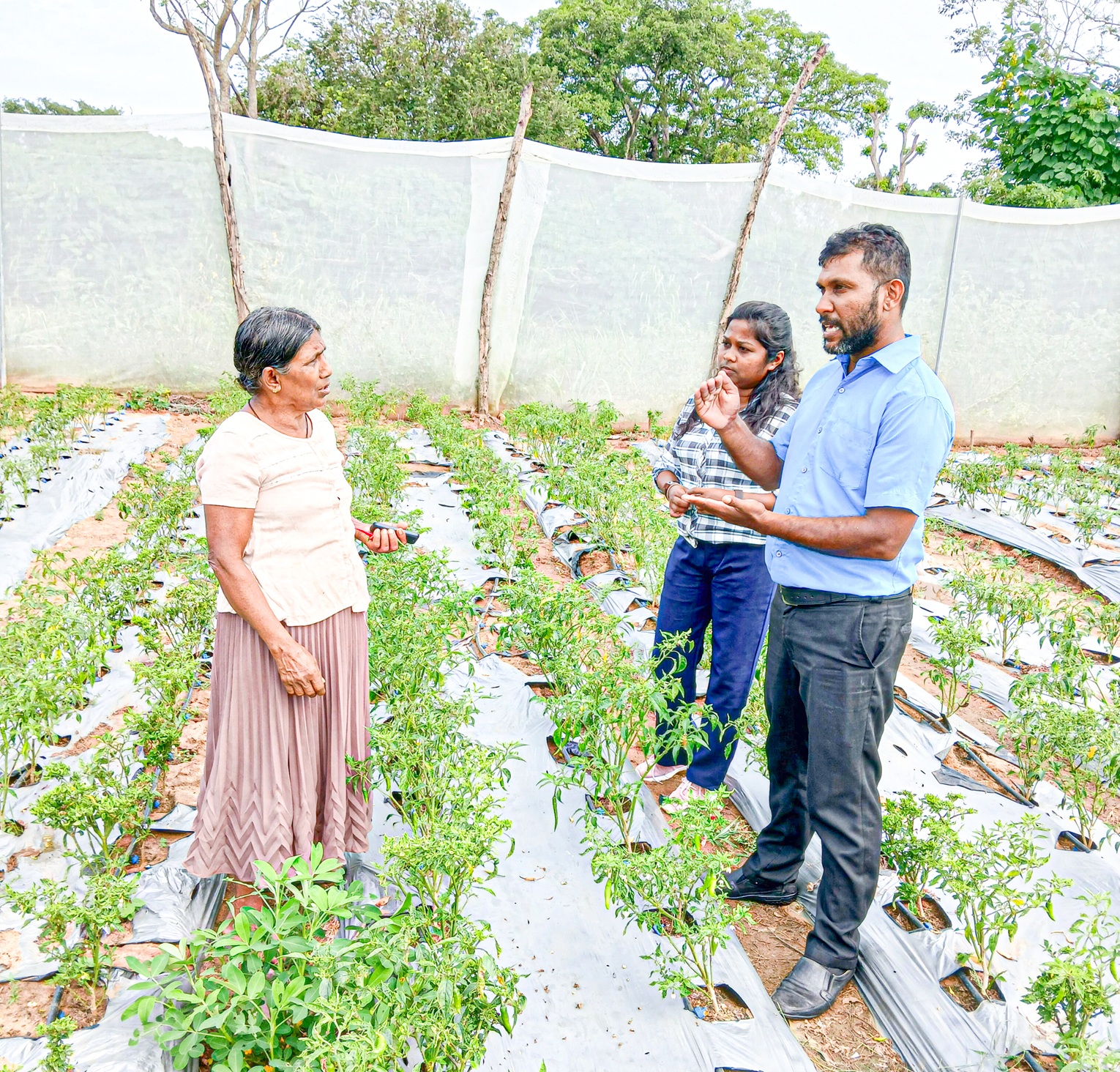
AI Mr. Malaka and AF Ms.Nuwanthi with the farmer
After receiving comprehensive training, including Climate Smart agriculture Practices, she carefully prepared the land, installed the drip irrigation system, and set up the insect-proof net. She began by cultivating the MICH-01 chilli variety. The first crop, which combined chemical fertilisers (applied via drip irrigation) with organic fertilisers, significantly outperformed conventional chilli crops. According to Mrs. Leelawathi:

  • The insect-proof net raised internal temperatures, reducing pest infestations and plant diseases.
  • The drip irrigation system ensured efficient water use and direct fertiliser application.
  • The poly-mulch helped retain soil moisture and suppress weeds, further reducing labour and irrigation costs.
  • The composting kit enabled her to produce her own compost fertiliser, which she used effectively in her cultivation. This not only reduced her dependency on external inputs but also improved soil fertility and contributed to sustainable farming practices

Her first harvest yielded 650–750 kg of chilli, with a production cost of around Rs. 25,000 and a return of approximately Rs. 150,000—a substantial profit that demonstrates the value of climate-smart agriculture. Mrs. Leelawathi’s story is a testament to the transformative power of knowledge, innovation, and dedication. Her success serves as a model for other farmers in the area.

 Story and photographs by K.A.A. Nuwanthi, Agriculture Facilitator, SP, CSIAP

Monday, 12 May 2025

The CSIAP Safeguard Progress Report - April (Phase II - 2025) Submitted to the WB

We are pleased to announce that the April 2025 Monthly Safeguard Progress Report for the Climate Smart Irrigated Agriculture Project (CSIAP) – Phase II – has been successfully submitted to the World Bank, in line with the Agreed Action Points discussed during the recent World Bank Mission (April 1–10, 2025).

This comprehensive report outlines key updates on environmental and social safeguard compliance and monitoring efforts across all project implementation areas. It reaffirms our ongoing commitment to: Sustainable irrigation infrastructure development, Livelihood protection, Stakeholder engagement, Biodiversity conservation and Grievance redress mechanisms.

Report Highlights:

  • Summary of the 2025 Annual Budget and Work Plan – Safeguard Sector Allocations
  • Implementation status of Solar-Powered Movable Seasonal Paddy Field Protected Electric Fences and current status of new requirements
  • Tree Planting Programmes at pre-schools and across catchment development areas
  • Environmental and Social Management Plan (ESMP) implementation updates
  • Operation of the Grievance Redress Mechanism (GRM)
  • Code of Conduct (CoC) and awareness sessions for Contractors, Farmer Organisations (FOs), Social Audit Committees (SACs), and Implementing Agencies
  • Grievance Redress Mechanism (GRM) Operations
  • Summary of actions agreed upon during the April 2025 World Bank Mission
  • Identification of key safeguard issues and corresponding mitigation measures

In addition, the report captures lessons learned, good practices, and province-wise monitoring summaries from the CSIAP implementation areas. The report also documents lessons learned, good practices, and province-wise monitoring summaries from across the CSIAP target areas.

 Access the full report via the link :🔗 Safeguard Progress Report(Phase II - 2025)

 Obtain the relevant annexes here :🔗Annexes – April 2025 Report

 "Please go to the Publications section of the CSIAP website: http://www.csiap.lk/, then navigate to the Safeguard Documents > Other Safeguard Documents, and look for the report listed there." 

Written by Ms. Sharmila Shanmuganthan, Social Safeguard and Gender Development Officer, PMU, CSIAP

Friday, 9 May 2025

Preschool Tree Planting Programme launched as part of the CSIAP Week in EP

The CSIAP is delighted to launch the Preschool Tree Planting Programme under CSIAP Week, marking a meaningful step towards nurturing a love for nature in our youngest generation. As part of the CSIAP Week celebrations, a Preschool Tree Planting Programme was launched at Galakadawala Preschool on 09 May 2025, under the patronage of Mr. Saman Bandulasena, Project Director of the Climate Smart Irrigated Agriculture Project (CSIAP).

 Planting a tree is more than just placing a seed in the soil—it is sowing the values of responsibility, care, and respect for the environment. Today, our preschool children, guided by their teachers and parents, have taken part in an act that symbolizes hope, growth, and a greener tomorrow. The event witnessed the enthusiastic participation of 52 children and 6 teachers from both Galakadawala and Gomarankadawala Preschools. In a significant step towards promoting environmental awareness among young learners, 60 Tom E JC mango plants and 60 coconut seedlings were distributed to children to be planted at their homes.

By giving each child a mango or coconut seedling,  the CSIAP encourages hands-on learning and strengthens the bond between families and nature. These small hands planting tiny saplings will one day grow into strong trees, just like our children, growing into responsible citizens of the world. The highlight of the event was the ceremonial tree planting at the preschool premises by the CSIAP official,s including Project Director Mr. Bandulasena and Mr. Sampasivam Naveendrathas, the newly appointed Deputy Project Director of CSIAP for the Eastern Province.

This meaningful programme was coordinated and organised by Mr. T. Sekaran, Social Safeguard Officer of the CSIAP in  Eastern Province, with the aim of officially launching the CSIAP Week in the province. The event emphasised both environmental stewardship and community engagement, aligning with CSIAP's broader goals. Agriculture Facilitators from Gomarankadawala and Pankulam and parents of preschool children also took part, further reinforcing the message of cultivating a greener future through collective action and early education.

Story and photographs by T. Sekaran, Social Safeguard Officer, Eastern Province, CSIAP.

Ensuring Safety First: Landmine Clearance at Vavetti Kulam Tank Site, Mullaitivu

As part of the ongoing rehabilitation under the Climate Smart Irrigated Agriculture Project (CSIAP), an antipersonnel landmine was discovered at the Vavetti Kulam tank site in Mullaitivu District. Immediate safety protocols were enacted, and the site was promptly secured to prevent harm. The incident was reported without delay on 11 April 2025 to the Project Management Unit (PMU)’s Safeguard Team, the Project Director, and the World Bank’s Safeguard and Task Teams. In response, the World Bank Safeguard Team provided specific guidance to mitigate risks and ensure full compliance with safeguard standards. The following measures were implemented:

  • Pre-screening and Scanning: All high-risk sites, particularly those near forested or formerly conflict-affected areas, must undergo thorough pre-screening to detect potential hazards and prevent future delays.
  • Mine Clearance Certification: No rehabilitation activities may resume without an official clearance certificate from accredited mine action authorities. The Vavetti Kulam site has since received formal certification from The HALO Trust.
  • Safety Screening and Stakeholder Engagement: Hazard assessments and structured safety briefings are now mandatory to safeguard workers and surrounding communities.
  • Awareness Programs: Comprehensive sessions on landmine awareness and Occupational Health and Safety (OHS) protocols will be conducted for contractors and Social Audit Committee members at all CSIAP sites.

 Before recommencing rehabilitation activities, The HALO Trust completed a final clearance and completion survey at Vavetti Kulam. The resulting mine clearance report was submitted to the PMU and the World Bank for official record. As a final precaution, awareness and safety training will be held for all site workers and Social Audit Committee members, underscoring CSIAP’s commitment to ensuring safety and community involvement. This incident highlights the critical importance of conflict-sensitive planning and robust risk management in post-conflict development initiatives. The full documentation—including certificates, correspondence, and photographs—is available in the official project records.

Please click Identified Antipersonnel Landmines at the Vavetti Kulam Tank Site in Mullaitivu District  to read it, and click the Clearance Certificate to read it.

Written by Ms. Sharmila Shanmuganathan, Safeguard Division, PMU, CSIAP

Submission of Bi-Annual Safeguard Progress Report – Phase II (2025)

The Climate Smart Irrigated Agriculture Project (CSIAP) is pleased to announce the successful submission of its Bi-Annual Safeguard Progress Report for Phase II of the 2025 implementation year to the World Bank. This submission complies with the Environmental and Social Framework (ESF) requirements set forth by the Bank’s safeguard policies.

The comprehensive report outlines significant progress and updates on environmental and social safeguard compliance and monitoring across all project areas. It highlights our continued commitment to sustainable irrigation infrastructure development, livelihood protection, stakeholder engagement, biodiversity conservation, and robust grievance redress mechanisms.

The CSIAP extends its sincere gratitude to all stakeholders and partners whose collaboration has been instrumental in achieving this milestone

Highlights of the report include:

  • Environmental and Social screening of 179 irrigation schemes
  • Progress on tank rehabilitation and cascade management
  • Clearances from the Forest Department and the Department of Wildlife Conservation
  • Livelihood impact assessments and mitigation strategies
  • Active functioning of Social Audit Committees and Grievance Redress Mechanisms
  • Community participation and gender-inclusive development
  • Success stories include solar-powered electric fences for crop protection
  • Implementation of the Code of Conduct to prevent Gender-Based Violence
  • Environmental and Social Impact Management Plan (ESMP) Monitoring with the Photo evidence.

The report also documents lessons learned, good practices, and province-wise monitoring summaries across the CSIAP’s target areas. The full report is now accessible through our website under the "Publications" section. 

In addition to that, please click  The Bi-Annual Safeguard Progress Report on 20th March 2025  to read the report and click  Annexes of the above report to refer.

By Sharmila Shanmuganthan, Safeguard Division, PMU, CSIAP

Thursday, 8 May 2025

CSIAP Strengthens Field-Level Activities to Enhance Project Outcomes in the NWP

The Climate Smart Irrigated Agriculture Project (CSIAP) has intensified efforts to expedite its ongoing tank rehabilitation programme in the North Western Province (NWP). A special progress review meeting on tank rehabilitation work with contractors was held this morning (May 8) at Mahagethara Holiday Resort in Kurunegala, chaired by Mr. S.M. Saman Bandulasena, Project Director of the CSIAP. Mr. H.M.P. Bandara, Deputy Project Director for the NWP, warmly welcomed participants and outlined the meeting’s objectives, emphasizing the importance of collaboration, accountability, and adherence to timelines in achieving project milestones.

During the session, Mr. Bandulasena, Project Director of the CSIAP reiterated the urgency of completing all rehabilitation works within the stipulated timeframe. He stressed the pivotal role of contractors in ensuring the successful implementation of this crucial initiative, which aims to enhance climate resilience and agricultural productivity in the region. The meeting was organised and facilitated by Mr. Bandara and his dedicated provincial team, reflecting their continued commitment to the timely delivery of the project’s objectives. Senior officials from the Department of Agriculture Development in Kurunegala and Puttalam also attended the meeting, contributing their insights and support to the tank rehabilitation initiative.

Mr. R.M. Wijerathna, a 57-year-old farmer from Koskotagolla, Rambe, actively participated in on-site Climate-Smart Agriculture (CSA) training under the CSIAP project. In addition to this, he received further training at the CSA Farmer Training School in Thirappane. With support from the project, Mr. Wijerathna was provided with a solar pump and a micro-irrigation system to enhance his agricultural practices. before the interseason period, he received groundnut and green gram seeds, as well as insect-proof nets to support intercropping. He also cultivates Cavendish bananas with assistance from the project. His successful adoption of CSA practices caught the attention of Mr. Bandulasena, Project Director of the CSIAP, who visited his field during the NWP’s progress review to witness the farmer’s achievements firsthand.

Mr. S.G.I.P. Karunarathna, Agriculture Instructor in Rambe, played a pivotal role in the successful cultivation of Cavendish banana by providing timely and practical technical guidance, along with the confidence and encouragement required by farmer Mr. R.M. Wijerathna to adopt improved cultivation practices. His continuous field-level support helped the farmer overcome initial challenges and implement climate-smart and productive farming techniques effectively.

Mr. Karunarathna also had the opportunity to explain to Project Director Mr. Bandulasena the systematic approach he followed in supporting the farmer throughout the entire cultivation process, from land preparation to crop management. Recognizing the impact of this hands-on guidance, the Project Director highly appreciated the significant contribution made by Mr. Karunarathna in ensuring the success of the farmer’s banana cultivation through his dedication, technical expertise, and sustained support.

Mr. G.B. Chandana, a 51-year-old farmer from Moragoda, Rambe, has successfully cultivated tomatoes with the significant support of the CSIAP. He was provided with a micro irrigation system, poly mulch, tomato seeds, insect-proof netting, and GI pipes, which greatly enhanced his cultivation practices. Mr. Chandana also received practical training both onsite and at the CSA Farmer Training School in Thirappane, equipping him with valuable knowledge and skills in climate-smart agriculture. 

Mr. H.G.V.G. Nimal Karunarathna, a 61-year-old farmer from Moragoda, Rambe, received essential support from the CSIAP to successfully cultivate capsicum and chilli. The project provided him with a micro irrigation system, poly mulch, and insect-proof netting with GI pipes, along with capsicum and MICH1 chili seeds. To further enhance his skills, Mr. Karunarathna participated in on-site CSA training as well as formal training at the CSA Farmer Training School in Thirappane. The farmer is exchanging views on his cultivation with Mr. S.G.I.P. Karunarathna, the Agriculture Instructor in Rambe, who consistently provides guidance and support.

Agriculture Instructor Mr. Karunarathnan conducts the Farmer Business School Training Programme on behalf of the CSIAP for members of the Other Field Crops Producer Society in Potthuwepitiya, Mahawewa. Mr. Karunarathna makes his utmost effort to develop the business and marketing skills of the CSIAP farmers, contributing significantly toward achieving the project's development objectives. In addition to his work on capacity building, he also provides invaluable technical guidance and support to help farmers in Rambe cultivate successfully. The CSIAP sincerely appreciates the dedicated service he continues to provide to uplift the farming community.

A special thanks to Ms. Imesha Dissanayake, Agriculture Facilitator in Rambe, for her dedication and tireless efforts toward the betterment of farmers. Her consistent presence at the ground level and strong rapport with the farming community have been instrumental in driving progress toward our project development objectives. We also extend our sincere appreciation for providing the necessary information and photographs that contributed to the writing of this article. 

By Samantha Mallawaarachchi, IEC & ICT Specialist, PMU, CSIAP