Friday, 3 March 2023

The World Bank Vice President receives a token of appreciation from MoA

Mr. Martin Raiser, South Asian Vice President of the World Bank receives a token of appreciation prepared by the Climate Smart Irrigated Agriculture Project (CSIAP)  during the observation tour at the Farmer Training School ( FTS) in Thirappane, Anuradhapura from Mr. Gunadasa Samarasinghe, Secretary of Agriculture recently. 
The FTS, which has been designed to build the capacity of project beneficiaries for the use of Climate Smart Agriculture (CSA) technologies and combat the adverse impact of climate change, was built at a cost of Rs. 40 million by the Climate Smart Irrigated Agriculture Project funded by the World Bank and implemented under the Ministry of Agriculture. The FTS where Mr. Faris H. Hadad-Zervos and Ms. Chiyo Kanda laid foundation stones on 22nd December 2021, was declared open by Hon. Mahinda Amaraweera, the Minister of Agriculture on 04th December 2022.  

"The FTS prepares SL farmers for climate change" Martin Raiser, RVP of the WB

 The first ever Climate Smart Farmer Training School in South Asia established at Thirappane will prepare Sri Lankan farmers for climate change, said Mr. Martin Raiser, World Bank Vice President for South Asia during a visit to the Farmer Training School (FTS) at Thirappane, Anuradhapura recently. What the farmers learn here is how to conserve water and how to use new planting techniques. I was told, with these techniques they can increase income by 30% and reduce the water that they need to irrigate by more than half,” Mr. Raiser added.

The World Bank’s Vice President visited the FTS in the company of Mr. Faris H. Hadad-Zervos, Country Director of the World Bank for Nepal, Maldives and Sri Lanka, Ms. Chiyo Kanda, Country Manager of the World Bank for Maldives and Sri Lanka and other World Bank officials. The FTS, built at a cost of Rs. 40 million by the World Bank-funded Climate Smart Irrigated Agriculture Project (CSIAP) and implemented by the Ministry of Agriculture, has been designed to build the capacity of project beneficiaries for the use of Climate Smart Agriculture (CSA) technologies and combat the adverse impacts of climate change. Mr. Faris H. Hadad-Zervos and Ms. Chiyo Kanda laid foundation stones for the FTS on 22 December 2021, and the school was declared open by Hon. Mahinda Amaraweera, the Minister of Agriculture on 4 December 2022.

Expressing his views, Mr. Raiser said, “The Farmer Training School at Thirappane is a great project. Very happy to see the first Climate Smart Farmer Training School in South Asia and how Sri Lankan farmers are being prepared for climate change.” When inquired about advancing FTS up to international standards, Mr Raiser responded, “There is a lot of international learning that is possible. Some techniques, such as mulching and drip irrigation I see here, have been used in other countries like China. However, lot of the knowledge needs to be local – you need to understand the local crops and the local soil. Sri Lanka has the capacity, with some international support, to develop a top class system yourselves.” “We also have internationally renowned Agriculture Experts who can come here and talk to local scientists to develop the right solutions together,” added Mr. Raiser.

A part of the CSIAP project is focusing on the rehabilitation of local irrigation systems. This system retains rainwater and then transmit it along irrigation channels onto the command area of the CSIAP. Several of Sri Lanka’s irrigation channels, draining systems and tanks are currently dilapidated and silted up. This means they can store less water and the soil is salinized; thus, more land erodes into tanks. This reduces the effectiveness of the agriculture systems in Sri Lanka. The goal of CSIAP is to rehabilitate local irrigation systems and improve farmer knowledge to ensure Sri Lanka’s future in climate-smart agriculture and help generate higher incomes for farmers.

“My message to Sri Lankan farmers is to continue to study and learn. Do not just do everything that you have done. Find a better way to do it. Talk to each other, communicate, learn from others, and share experiences. That’s why a school like this is here.”

The Vice President, Country Director and Country Manger awarded certificates to Farmer Leaders from Gomarankadawara Agrerian Service Center Division in Eastern Province of  the 6th group who undertook a 3-day Residential Training Programme at the FTS. To mark this occasion, Mr. Raiser received a token of appreciation prepared by the CSIAP from Mr. Gunadasa Samarasinghe, Secretary of Agriculture at the event.

Eng. R.M.B. Rajakaruna, Project Director, Climate Smart Irrigation Agriculture Project presented a report on the current progress of the project. Some of the farmers who participated in the training programme expressed their views regarding the benefits they received due to the project.

Mr. Vijaya Wanasinghe, Provincial Secretary of Agriculture, North Central Province, Ms. K.N.C Gunawardhana, Director, Dr. Wasantha Mallawaarachchi- Principle Scientist,  Dr. M.S. Nijamudeen, Principle Scientist, Field crop & Research Development Institute, Mahailuppallama, Ms. Sandya N.G Abeysekara, Additional District Secretary, North Central Province, representatives of implementing agencies, farmers and CSIAP staff attended in this event.

Wednesday, 1 March 2023

The CSIAP continues forming Management Committees in Southern Province

The overall objective of the Cascade Management Committees (CMCs)  is to restore and improve the watershed system through integrated management and manage water and associated natural resources in a sustainable manner to enhance the living standards of rural communities. In order to achieve to above objective, an awareness programme and nominating framer leaders for CMC were conducted at Yodawewa Beach Hotel in Tissamaharama by the Deputy Project Director’s Office of the Climate Smart Irrigated Agriculture Project (CSIAP).  Mr. Mahinda Suwandaarachchi, Deputy Project Director  (Southern Province)  of the CSIAP explained the importance of the CMCs at this programme which was attended by 78 farmer leaders. Mr. R.P.M. Dissanayake, Institutional Development and Capacity Building Specialist (Southern Province and Mr. D.V. Bandulasena, Institutional Development and Capacity Building Specialist(Project Management Unit of the CSIAP also made farmer leaders aware of forming CMCs.

Strengthening the institutional framework in the cascade is identified as one of the key requirements for managing the cascade system. Therefore, CMCs are to be formed, consisting of the farmer Organizations and local level officials for resources (water and land) management at the cascade level. The CSIAP will establish 30 CMCs in North Western, 12 CMCs in North Central, 10 CMCs in Northern, 12 CMCs in Eastern, 07 in Southern and 09 CMS in Uva provinces respectively.

Story by R.P.M. Dissanayake (Institutional Development & Capacity Building Specialist), SP, CSIAP

Tuesday, 21 February 2023

“Today is International Mother Language Day”

International Mother Language Day is observed on February 21st every year to promote linguistic and cultural diversity and multilingualism.  It recognizes that languages and multilingualism can advance inclusion, and the  Sustainable Development Goals focus on leaving no one behind. The day was first proclaimed by the General Conference of the United Nations Educational, Scientific and Cultural Organization (UNESCO) in November 1999, and has been celebrated annually since 2000.

The purpose of the day is to celebrate the diversity of languages and cultures around the world and to promote awareness of the importance of preserving and protecting linguistic diversity. It also aims to promote the use of mother languages in education and everyday life, as well as to encourage people to learn and use other languages. On International Mother Language Day, people around the world celebrate their mother tongues, organize cultural events, and participate in language-related activities to promote linguistic and cultural diversity.

The Climate Smart Irrigated Agriculture Project (CSIAP) funded by the World Bank and implemented under the Ministry of Agriculture uses mother languages to achieve project development objectives in areas where the CSIAP is being implemented in the following way.

1. Effective communication: It is the most natural way of communication for individuals, and using it in agriculture ensures clear and precise communication. In rural areas, farmers may not have a strong grasp of the official language or other languages used in agriculture, and communicating with them in their mother language can help them understand technical information better.

2. Transfer of knowledge and traditional practices: It is often closely tied to the cultural and traditional practices of a community. Using it in agriculture can facilitate the transfer of knowledge and traditional practices from one generation to the next. This is especially important in agriculture, where traditional practices and knowledge can play an important role in sustainable farming and the conservation of natural resources.

3. Engagement and empowerment: Using the mother language in agriculture can help engage and empower farmers who may feel excluded or marginalized due to their limited knowledge of the official language or other languages used in agriculture. This can help create a sense of belonging and community, which can motivate farmers to take an active interest in their work and participate in decision-making processes.

      4. Promotion of local products and culture: It is often closely linked to the culture, identity, and values of a community. Using it in agriculture can help promote local products and culture, which can be beneficial for local economies and the preservation of cultural heritage.

Mother language plays an important role in agriculture by facilitating communication, access to resources, building relationships, and sharing knowledge and best practices. Overall, using the mother language in agriculture can have significant benefits for effective communication, knowledge transfer, empowerment, and the promotion of local products and culture and it can also help create a more inclusive and sustainable agricultural sector to reach the CSIAP’s objectives.

Image: Curtsey of the UN. 

Monday, 20 February 2023

A workshop on "Hydrological Studies Using Software Applications" in NCP

 "Hydrological Studies Using Software Applications", the second one of the workshop series was conducted for engineering and technical staff of the Provincial Irrigation Department, District Agrarian Department and Department of Irrigation in North Central Province by the Design Cell of the Climate Smart Irrigated Agriculture Project (CSIAP) at the Creston Park Hotel, Anuradhapura recently. The purpose of the workshop was to equip Sri Lankan engineers with knowledge and skills to use software related to Hydrological Studies and to transfer the knowledge gained by the Design Cell of the CSIAP to Implementing Agencies and other authorities related to the Irrigation sector.

This workshop, which was held in two sessions of one week each, had been initiated under the instructions of  Eng R.M.B. Rajakauruna, Project Director, the CSIAP and this workshop was guided by the Senior Engineering Consultant Eng. H.G.M.Kulasinghe.  Project Engineering Consultants Eng. R.M.H.N Bandara and Eng. P.H.S. Rangika made their contribution to the workshop as resource persons along with the Engineering Trainee Mr. B.D.M.S.B Dissanayake. Participants received Certificates of participation in the workshop. Mr. S.M Seelarathne, Deputy Project Director (North Central Province) of the CSIAP of CSIAP (NCP) coordinated the workshop.

Friday, 17 February 2023

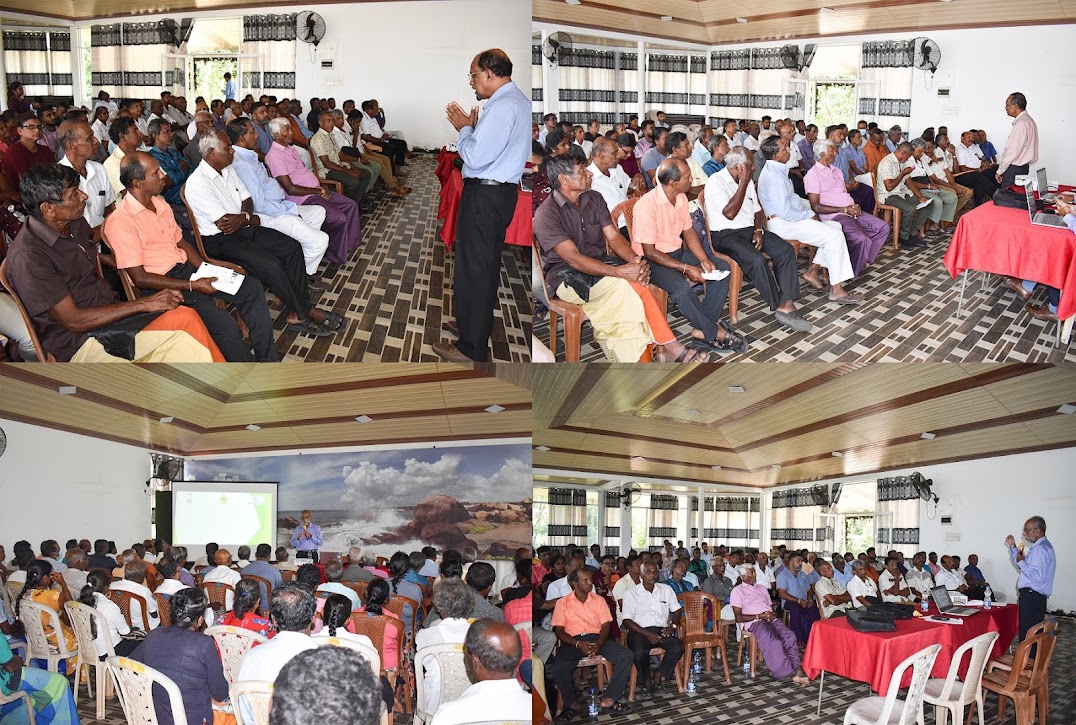
A training programme being conducted at the Farmer Field School in Thirappane

The Farmer Field School (FFS)at Thirappane trains farmers and give hands-on experience on Climate Smart Agriculture (CSA) practices to address the challenges of building strategies for climate change mitigation, adaptation, and food security (crop productivity),  which are closely related to agriculture and minimize their potential negative impacts and technologies to the beneficiary farmers of hot spot areas in 11 districts of six provinces such as North Western, North Central, Northern, Eastern, Uva and Southern Provinces where the CSIAP is being implemented. The FFS project costs around Rs 40Mn and the Ministry of Agriculture is the main agency responsible for executing the project.  The Climate Smart Irrigated Agriculture Project (CSIAP) funded by the World Bank and implemented under the Ministry of Agriculture. increases and builds the capacities of farmers for the use of CSA technologies to combat the climate change impact. The project aims to build a village-level resource person pool with the competencies of CSA technologies & practices from support organization officials and selected leader farmers through the newly established FFS.

 The main objective of FFS is to enhance the capacities of support organization officials and farmer leaders to promote CSA technologies and practices in their villages. Subsequently, the project aims to impart their knowledge and skills on CSA practices to village-level potential farmers to respond to the adverse climate impacts in their villages. In addition, the project mobilizes trained leader farmers to organize training activities and disseminate knowledge on CSA practices among peer groups. All training programs are conducted with the collaboration of the Extension division of the Department of Agriculture (DOA), Peradeniya, including the allocation of potential resource persons for training sessions. All sessions are to be organized as residential (03 days) intensive, multi-session and multi-activity group learning sessions that use lectures, group discussions, demonstrations of practical activities, videos, and other audio-visual resources as well as entertainment activities (drams and role play), etc.

The fifth o training programme is being conducted presently at the FFS with the participation of 18 lead farmers including 05 women from the Thunukkai Agrarian Service Centre area in Mullaitivu Districts.  Apart from the in-house lectures delivered, farmers were given hands-on experience in the field by subject specialists.

Dr. T. Karunainathan, Deputy Director (Research), Dr. M.S. Najiamudeen, Principal Agriculture Scientist at  Field Crops Research and Development Institute (FSRDI) in Mahailluppallama delivered lectures and provided participants with hand on experience in both cultivation and irrigation areas.  Mr. Farnk Jayasinghe, CSA Specialist (PMU), Mr. W.K..P.C Perera, Agri-Business & Market Linkage Specialist, Mr. Samantha Mallawaarachchi, IEC & ICT Specialist, Ms. Sharmila Shanmuganathan, Gender Development Officer of the CSIAP also delivered lectures in their subject areas at FFS.

Wednesday, 8 February 2023

Four Tanks renovated in NWP at a cost of Rs 13.42M declared open by the CSIAP

 Four tanks such as Galatabedi wewa, Katupitigama wewa, Kumbukgete wewa, and Ambagaha wewa located in the Ambanpola Agricultural Service Center area in Kurunegala District renovated at a cost of Rs 13.42 million by the Deputy Project Director’s Office of the Climate Smart Irrigated Agriculture Project (CSIAP) in North Western Province (NWP) were declared open recently and handed over to farmers to use for agricultural activities. 164 farming families living in the area will be benefited from these four tanks

The Provincial Office of the CSIAP in NWP has already started renovating 141 tanks in the provinces investing Rs 1661 million to boost the agricultural economy which leads to improving the livelihood of the farming community in the project area. As the chief guest, the Provincial Secretary of Agriculture Mr. D. M .K. Chandana  Dissanayake unveiled plaques of tanks and poured pots of milk into tanks to mark the opening.  Deputy Project Director of CSIAP in NWP Mr. W.M.S Wijesinghe opened sluice gates and handed certificates of completing the renovation of tanks to farm organizations. Invitees to the event planted trees and a traditional ceremony was also held to bless the cultivation and farming community too.

The Divisional Secretary in Ambanpola Mrs. H.M.C.J. Herath, Director of the Provincial Department of Agriculture Mr. P. Sisira Kumara, Director of Provincial Irrigation Mr. W. Kamalsiri, around fifty government officers representing provincial departments,  over 120 farmers, Deputy Project Director of CSIAP in NWP Mr. W.M.S Wijesinghe and his staff attended this programme.

Story and Photographs by Chamara Basnayake (Agriculture Facilitator), Rajanganaya ASC, NWP