 |
| The CSIAP Project Director Eng. R.M.B. Rajakaruna addressing audiance |

Friday, 4 March 2022
Reorientation workshop to speed up CSIAP’s activities and achieve targets in 2022
Tuesday, 15 February 2022
The 06th National Project Steering Committee Meeting of the CSIAP commences

The
06th National Project Steering Committee (NPSC) Meeting of the Climate Smart
Irrigated Agriculture Project (CSIAP) is being held this morning (15th) at the
Ministry of Agriculture. The NPSC meeting is chaired by Mr. D. M.L.
Bandaranayake, Secretary to the Ministry of Agriculture. The NPSC is set up at
the Ministry of Agriculture to take the overall responsibility in executing the
CSIAP. The NPSC will consist of key officials of the major stakeholder agencies
of the central government, and provincial government mainly to provide policy guidance to the project
and to ensure achieving CSIAP’s objectives.
The World Bank Officials joined the meeting remotely, and Chief Secretaries of provinces where the CSIAP is being implemented, Heads of Government Departments, Senior Officials of implementing agencies, Project Director, Provincial Deputy Project Directors and senior officials of the CSIAP were also present in this meeting. Please click NPSC to see images of the meeting
The Chief Secretaries Meeting of the CSIAP’s areas commences at the MoA

The Chief Secretaries Meeting of the six provinces, where the Climate Smart Irrigated Agriculture Project (CSIAP) is being implemented, has been held this morning (15th) at the Ministry of Agriculture under the patronage of Mr. D. M.L. Bandaranayake, Secretary to the Ministry of Agriculture. Secretaries representing North Western, North Central, Northern, Eastern, Uva and Southern, top officials of the ministry, Project directors, Provincial Deputy Project Directors and senior officials of the CSIAP were also present in this meeting. Please click Images to see events of the meeting.
Wednesday, 9 February 2022
The CSIAP's Tree Planting Programme on Sri Lanka's 74th Independence Day

Climate change impacts have greatly affected Sri Lanka in terms of flooding, drought and food insecurity. To address this situation, the CSIAP’s Tree Planting Programme represents an excellent way of contributing to the much-needed reforestation. Caring for trees and the environment are the social responsibility of every individual. The Tree Planting Programme of the CSIAP was a platform for those, who are in hot spot areas where the CSIAP is being implemented, to actively participate in the greening of the country by planting trees.
Please click NWP and EP to watch the visuals of the Tree Planting Programme held in North Western and Eastern Provinces and click NP, UP, SP, EP and NWP to see images of this programme held in Northern, Uva, Southern, Eastern and North Western Provinces.
Thursday, 3 February 2022
Farmers receive 478 farm machinery worth Rs. 250 Mn procured by the CSIAP
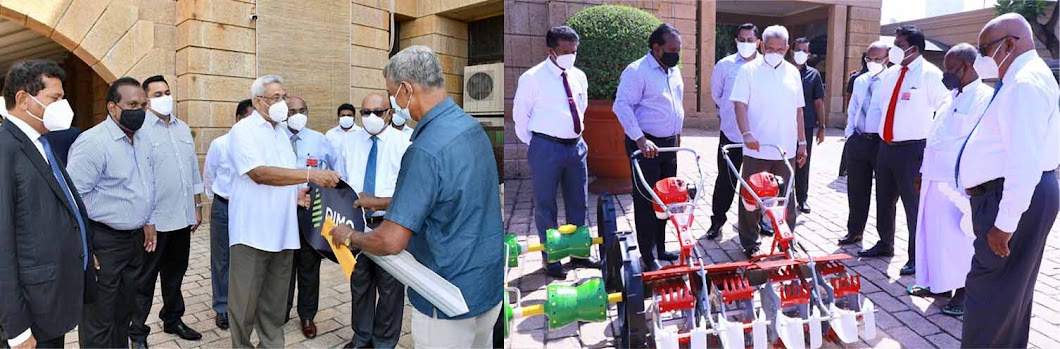 |
| The President hands over a symbolic key to a farmer and President inspects machinery |
President Hon. Gotabhaya Rajapaksa handed 478 farm machineries worth Rs. 250 Mn purchased by the Climate Smart Irrigation Agriculture Project (CSIAP) over to farmers living in hots spot areas affected by climate change to carry out their agricultural activities. This ceremony took place at the Presidential Secretariat this morning.
Farmers will be able to obtain above farm machinery through 47 Agrarian Service Centers established in six provinces covering hot spot areas, which are highly vulnerable to climate variations in 11 districts such as Anuradhapura, Polonnaruwa, Kurunegala, Puttalam, Kilinochchi, Mutative, Trincomalee, Batticaloa, Ampara, Monaragala and Hambantota, to engage in their agricultural activities.
Marking the handing over the programme, President Rajapaksa made symbolic hand over of selected machinery to farmers. The machinery, totalling 478 individual items, include 189 Walk Behind Type Paddy Transplanters, 189 Lowland Power Weeders, 95 Drum Type Manual Paddy Seeders, 04 Paddy Combined Harvesters and 01 Four Wheel Tractor.
The objectives of providing machinery to farmers by the Climate Smart Irrigated Agriculture Project is to enhance the living standards of the farmers affected by the Covid 19 epidemic and to boost the agricultural economy of the country which will bring social progress by increasing productivity, employment and income.
 |
| Machinery delivered today |
Please see more Images of this programme.
Wednesday, 26 January 2022
Zero Energy Cooling Chamber introduced by CSIAP to preserve Fruits and Veggies
 |
| Mr. Stephen Danyo and the World Bank team looking at ZECC intently on the left and Farm Manager Mr. K. Keerthihan explaining the ZECC on the right |
The ZECC an alternative of the common refrigerator. This is an on-farm storage chamber for fresh fruits, vegetables and flowers to extend their marketability. Storage of fresh horticultural produce after harvest is one of the most pressing problems of a tropical country like Sri Lanka. Due to high moisture content in the country, fruits and vegetables have very short life and are liable to spoil.
The ZECC can be constructed easily too. The chamber can keep the temperature lower than the outside temperature and maintain about 90% relative humidity. The ZECC would be ideal to use in the dry zone where the Climate Smart Irrigated Agriculture Project (CSIAP) is being implemented. The project is taking initiatives to introduce ZECC in its project area. The major advantage of cool chamber storage was the maintenance of fruits and Vegetables’ firmness by lowering the physiological loss in weight (PLW) and other metabolic processes. Eventually, 3 to 5 days more shelf life of fruits and vegetables could be obtained in cool chamber storage.
Mr.
Stephen Danyo, Sector Leader for Sustainable Development with Mr. S. Manoharan,
Senior Consultant (Agriculture, Food & Rural Development), Dr. Athula
Senaratne, Senior Agriculture Specialist & Kanishka Balasuriya, Consultant
at the World Bank visited recently to the District Agriculture Training Center
At Oddusudan, Mullaitivu to explore activities of the Climate Smart Irrigated
Agriculture Project (CSIAP) and Mr. Danyo was very much interested in ZECC too.
Monday, 24 January 2022
The IRLTP with US$ 1bn will be in 2022 with key lessons learned from the CSIAP
 |
| The Sector Leader for Sustainable Development Mr. Stephen Danyo addressing government officials |
The IRLTP will be implemented in Sri Lanka with key lessons learned from the Climate Smart Irrigated Agriculture Project (CSIAP), which began in 2019 with the World Bank financing facility of US $ 110m to improve productivity and climate resilience of smallholder agriculture in Sri Lanka, is designed to be implemented in six provinces of the dry zone covering 258 Grama Niladhari Divisions of in pre-identified hot spot areas -which are highly vulnerable to climate variations in 11 districts namely Anuradhapura, Polonnaruwa, Kurunegala, Puttalam, Kilinochchi, Mutative, Trincomalee, Batticaloa, Ampara, Monaragala and Hambantota, a senior official of the World Bank further added.
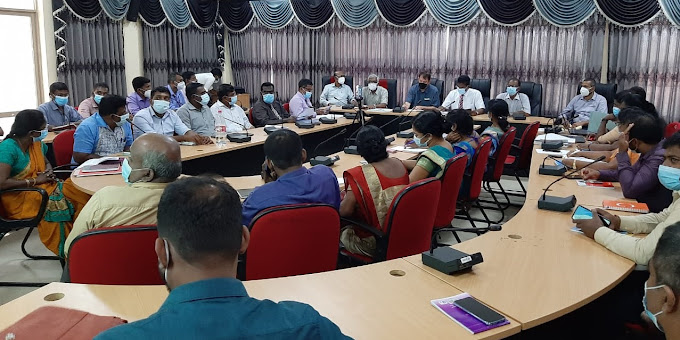 |
| Discussion between the World Bank team and Government Officials |
The Department of National Planning (DNP) jointly with line agencies has developed and submitted a concept for this development programme and it is presently been reviewed by the World Bank which wishes to have a series of consultations at the district level to consolidate
Since the proposed implementation mechanism is a novel concept for the World Bank, a number of discussions have been arranged to make them aware of the main functions of the District Secretariats and Divisional Secretariats in terms of development planning and implementation process. Accordingly, Mr. Stephen Danyo, Sector Leader for Sustainable Development with Mr. S. Manoharan, Senior Consultant (Agriculture, Food & Rural Development), Dr. Athula Senaratne, Senior Agriculture Specialist & Kanishka Balasuriya, Consultant at the World Bank, arrived in District Secretariate, Mullaitivu on 20th this month for a district-level discussion, that was chaired by Mr. K. Vimalanathan, District Secretary, Mullaitivu to have constructive dialogue on the planning process, with the key officers including Divisional Secretaries, Planning Directors, District Heads of relevant Departments such as Irrigation, Agriculture, Agrarian Development, Livestock and Dairy Development, Fisheries, Local Government, Rural Development, Forestry, Wildlife, Project Directors of ongoing projects.
This discussion gave the World Bank team to get more understanding of district/ divisional secretariat level contribution for project identification, formulation and implementation and monitoring mechanisms.
Subscribe to:
Posts (Atom)