Tuesday, 15 February 2022

The Chief Secretaries Meeting of the CSIAP’s areas commences at the MoA

The Chief Secretaries Meeting of the six provinces, where the Climate Smart Irrigated Agriculture Project (CSIAP) is being implemented, has been held this morning (15th) at the Ministry of Agriculture under the patronage of Mr. D. M.L. Bandaranayake, Secretary to the Ministry of Agriculture. Secretaries representing North Western, North Central, Northern, Eastern, Uva and Southern, top officials of the ministry, Project directors, Provincial Deputy Project Directors and senior officials of the CSIAP were also present in this meeting. Please click Images to see events of the meeting.

Wednesday, 9 February 2022

The CSIAP's Tree Planting Programme on Sri Lanka's 74th Independence Day

The Climate Smart Irrigated Agriculture Project (CSIAP) initiated a tree-planting programme at the provincial level covering 11 districts, where the CSIAP is being implemented, on 04th  this month to mark Sri Lanka’s 74th Independence Day. Over 1000 trees, which included Mango, Orange, Kaya, Mee, Kumbuk, Jack Fruits, Pomegranate and Lemon trees, were planted on this day.

Climate change impacts have greatly affected Sri Lanka in terms of flooding, drought and food insecurity. To address this situation, the CSIAP’s Tree Planting Programme represents an excellent way of contributing to the much-needed reforestation. Caring for trees and the environment are the social responsibility of every individual. The Tree Planting Programme of the CSIAP was a platform for those, who are in hot spot areas where the CSIAP is being implemented, to actively participate in the greening of the country by planting trees.

Please click NWP and EP to watch the visuals of the Tree Planting Programme held in North Western and Eastern Provinces and click NP,  UP, SP, EP and NWP to see images of this programme held in Northern, Uva, Southern, Eastern and North Western Provinces.

Thursday, 3 February 2022

Farmers receive 478 farm machinery worth Rs. 250 Mn procured by the CSIAP

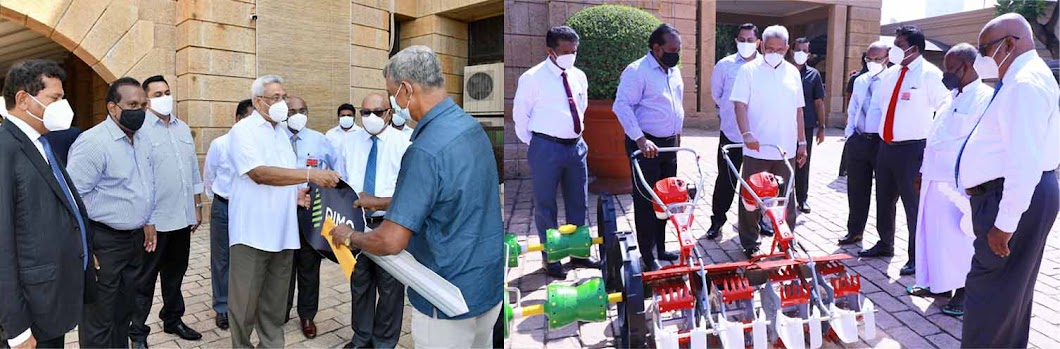
The President hands over a symbolic key  to a farmer and President inspects machinery   

President Hon. Gotabhaya Rajapaksa handed 478 farm machineries worth Rs. 250 Mn purchased by the Climate Smart Irrigation Agriculture Project (CSIAP) over to farmers living in hots spot areas affected by climate change to carry out their agricultural activities. This ceremony took place at the Presidential Secretariat this morning.

Farmers will be able to obtain above farm machinery through 47 Agrarian Service Centers established in six provinces covering hot spot areas, which are highly vulnerable to climate variations in 11 districts such as  Anuradhapura, Polonnaruwa, Kurunegala, Puttalam, Kilinochchi, Mutative, Trincomalee, Batticaloa, Ampara, Monaragala and Hambantota, to engage in their agricultural activities.

Marking the handing over the programme, President Rajapaksa made symbolic hand over of selected machinery to farmers. The machinery, totalling 478 individual items, include 189 Walk Behind Type Paddy Transplanters, 189 Lowland Power Weeders, 95 Drum Type Manual Paddy Seeders, 04 Paddy Combined Harvesters and 01 Four Wheel Tractor.

The objectives of providing machinery to farmers by the Climate Smart Irrigated Agriculture Project is to enhance the living standards of the farmers affected by the Covid 19 epidemic and to boost the agricultural economy of the country which will bring social progress by increasing productivity, employment and income. 

Machinery delivered today
Minister of Agriculture Hon. Mahindananda Aluthgamage,  State Minister Hon. Shasheendra Rajapaksa, Secretary to the President Mr. Gamini Senarath, Secretary of Agriculture Mr. D.M.L Bandaranayake,  CSIAP’s Project Director Eng. R.M.B. Rajakaruna,  Commissioner General of the Department of Agrarian Development Mr. A. H. M. L. Abeyrathna were present in this event. 

Please see more Images of this programme.

Wednesday, 26 January 2022

Zero Energy Cooling Chamber introduced by CSIAP to preserve Fruits and Veggies

Mr. Stephen Danyo and the World Bank team looking at ZECC intently on the left and Farm Manager   Mr. K. Keerthihan explaining the ZECC on the right
A Zero Energy Cooling Chamber (ZECC) is a small chamber made out of
materials like brick, sand, cement and gunny bag etc where farmers can store freshly harvested produce. The ZECC works on evaporative cooling principles that can be used to provide a cool environment.

The ZECC an alternative of the common refrigerator. This is an on-farm storage chamber for fresh fruits, vegetables and flowers to extend their marketability. Storage of fresh horticultural produce after harvest is one of the most pressing problems of a tropical country like Sri Lanka. Due to high moisture content in the country, fruits and vegetables have very short life and are liable to spoil.

The ZECC can be constructed easily too. The chamber can keep the temperature lower than the outside temperature and maintain about 90% relative humidity. The ZECC would be ideal to use in the dry zone where the Climate Smart Irrigated Agriculture Project (CSIAP) is being implemented. The project is taking initiatives to introduce ZECC in its project area. The major advantage of cool chamber storage was the maintenance of fruits and Vegetables’ firmness by lowering the physiological loss in weight (PLW) and other metabolic processes. Eventually, 3 to 5 days more shelf life of fruits and vegetables could be obtained in cool chamber storage. 

Mr. Stephen Danyo, Sector Leader for Sustainable Development with Mr. S. Manoharan, Senior Consultant (Agriculture, Food & Rural Development), Dr. Athula Senaratne, Senior Agriculture Specialist & Kanishka Balasuriya, Consultant at the World Bank visited recently to the District Agriculture Training Center At Oddusudan, Mullaitivu to explore activities of the Climate Smart Irrigated Agriculture Project (CSIAP) and Mr. Danyo was very much interested in ZECC too.

Please watch videos about ZECC in Sinhalese and Tamil

Monday, 24 January 2022

The IRLTP with US$ 1bn will be in 2022 with key lessons learned from the CSIAP

The Sector Leader for Sustainable Development Mr. Stephen Danyo addressing government officials
 The Integrated Rural Livelihood Transformation Project (IRLTP) is being formulated to accommodate the government priorities focusing rapid economic revival of Sri Lanka. The proposed project aims to restore and develop livelihoods in underserved rural areas in up to 25 Districts and to be implemented through the District Secretariats as the government has taken an initiative to have a comprehensive approach on rural development through district implementation mechanism, the World Bank sources said. This project, that costs US $ 01 billion, would include activities related to restoring/rehabilitation/protection of productive rural assets, consolidation of rural livelihoods, rural enterprise development etc, a senior official of the World Bank expressed.

The IRLTP will be implemented in Sri Lanka with key lessons learned from the Climate Smart Irrigated Agriculture Project (CSIAP), which began in 2019  with the World Bank financing facility of US  $ 110m to improve productivity and climate resilience of smallholder agriculture in Sri Lanka, is designed to be implemented in six provinces of the dry zone covering 258 Grama Niladhari Divisions of in pre-identified hot spot areas -which are highly vulnerable to climate variations in 11 districts namely Anuradhapura, Polonnaruwa, Kurunegala, Puttalam, Kilinochchi, Mutative, Trincomalee, Batticaloa, Ampara, Monaragala and Hambantota, a senior official of the World Bank further added. 
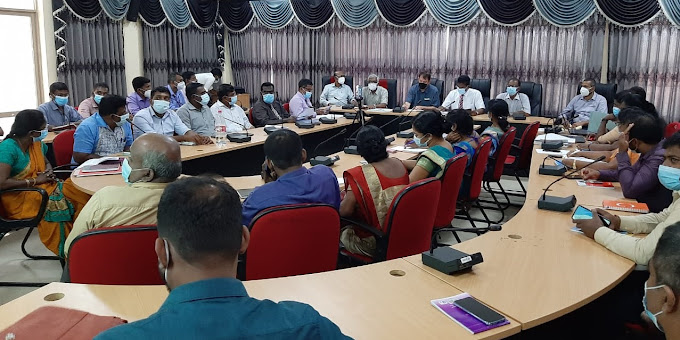
Discussion between the World Bank team and Government Officials

The Department of National Planning (DNP) jointly with line agencies has developed and submitted a concept for this development programme and it is presently been reviewed by the World Bank which wishes to have a series of consultations at the district level to consolidate

Since the proposed implementation mechanism is a novel concept for the World Bank, a number of discussions have been arranged to make them aware of the main functions of the District Secretariats and Divisional Secretariats in terms of development planning and implementation process. Accordingly, Mr. Stephen Danyo, Sector Leader for Sustainable Development with Mr. S. Manoharan, Senior Consultant (Agriculture, Food & Rural Development), Dr. Athula Senaratne, Senior Agriculture Specialist & Kanishka Balasuriya, Consultant at the World Bank, arrived in District Secretariate, Mullaitivu on 20th this month for a district-level discussion, that was chaired by Mr. K. Vimalanathan, District Secretary, Mullaitivu  to have constructive dialogue on the planning process, with the key officers including Divisional Secretaries, Planning Directors, District Heads of relevant Departments such as Irrigation, Agriculture, Agrarian Development, Livestock and Dairy Development, Fisheries, Local Government, Rural Development, Forestry, Wildlife, Project Directors of ongoing projects.

This discussion gave the World Bank team to get more understanding of district/ divisional secretariat level contribution for project identification, formulation and implementation and monitoring mechanisms.

Thursday, 20 January 2022

Sector Leader for Sustainable Development at the WB visits the CSIAP's area in NP

Sector Leader was interested in knowing organic fertilizer production
Mr. Stephen Danyo, Sector Leader for Sustainable Development at The World Bank arrived in Oddusudan, Mullaitivu this afternoon (20th) to inspect activities of the Climate Smart Irrigated Agriculture Project (CSIAP) in the Northern Province. He visited the District Agriculture Training Center in Oddusudan which conducts a number of agricultural programmes on its premises in collaboration with the CSIAP.

Mr. S. Manoharan, Senior Consultant (Agriculture, Food & Rural Development), Dr. Athula Senaratne, Senior Agriculture Specialist & Kanishka Balasuriya, Consultant at the World Bank, Eng. R.M.B. Rajakaruna, Project Director, Mr. George Chandra Babu, Deputy Project Director- Northern Province & Specialists & other staff of the CSIAP, Mr. Kirubakaran Keerthihan, Farm Manager of the District Agriculture Training Center and farmers were also present.

Please watch the Video Clip of his tour in Northern Province.

Friday, 14 January 2022

CSIAP Hands Over Farm Machinery Worth Rs. 65.81M to Strengthen CS Farming

In a significant move to enhance agricultural productivity and support farming communities in climate-vulnerable regions, the Climate Smart Irrigated Agriculture Project (CSIAP) recently handed over a range of farm machinery valued at Rs. 65.81 million to the Department of Agrarian Development (DAD). The initiative aims to strengthen mechanized farming services for farmers living in hotspot areas where the CSIAP is currently being implemented.

The official handover ceremony was held at the Ministry of Agriculture, with the machinery formally presented by CSIAP Project Director, Eng. R.M.B. Rajakaruna, to Mr. A. H. M. L. Abeyrathna, Commissioner General of the Department of Agrarian Development. The event marked another milestone in CSIAP’s continued efforts to modernize Sri Lanka’s agricultural sector through climate-smart investments.

Supporting Farmers with Modern Technology
The consignment of machinery includes a total of 194 individual items, comprising 189 Lowland Power Seeders, four Paddy Combined Harvesters, and one Tractor. These machines are expected to significantly improve farming efficiency, reduce labor constraints, and support timely land preparation, planting, and harvesting activities—particularly in areas affected by climate variability. Lowland Power Seeders will help ensure uniform planting while saving time and labor, whereas Paddy Combined Harvesters will enable faster and more efficient harvesting, minimizing post-harvest losses. The tractor will further strengthen mechanization support services managed by the DAD for farmer use.

 Strengthening Institutional Collaboration
The Ministry of Agriculture warmly welcomed the CSIAP’s support in procuring this essential machinery, emphasizing its importance in improving access to modern agricultural equipment for smallholder farmers. By handing over the machinery to the Department of Agrarian Development, the CSIAP ensures that these assets will be managed, deployed, and maintained through established institutional mechanisms, allowing farmers to access them as needed during critical farming periods. Senior officials from the Ministry of Agriculture, Department of Agrarian Development, and CSIAP participated in the ceremony, highlighting the strong collaboration among institutions working together to promote sustainable and resilient agriculture.

 Advancing Climate-Smart Agriculture
This investment reflects the CSIAP’s broader commitment to promoting climate-smart irrigated agriculture by combining infrastructure development, modern technology, and institutional strengthening. By improving mechanization in hotspot areas, the project supports farmers in adapting to climate challenges while increasing productivity and profitability.  Through initiatives such as this, the CSIAP continues to empower farming communities, modernize agricultural practices, and contribute to the long-term sustainability and resilience of Sri Lanka’s agriculture sector. Please see more images of the event.