
1. Video 2. Slide Show and 3. The Full Speech of the Country Director after laying foundation stones
And click to read 4. The full story of the Country Director’s vist at Thirappane


I would like to know what more we can do to support you. What else we can do to move forward. I think it is very important said Mr. Faris. H. Hadad-Zervos, Country Director of the World Bank at a special ceromancy organized to lay the foundation stone to commence the construction work of the Farm Field School at Thirappane on 22nd this month.
The World Bank Country Director, Ms. Chiyo Kanda, Country Manger and other officials were welcomed by Eng. R.M. B. Rajakaruna, Project Director, staff of the CSIAP and farmers, and escorted to the ceremonial ground by a cultural procession. The Country Director and Country Manager unveiled the plaque of the FFS. Secondly, distinguished guests planted saplings to remark the event and laid foundation stones with the Project Director, CSIAP and farmers. The project Director of CSIAP made the welcome speech and the Country Director addressed the audience. Both male and female farmers had an opportunity to express their ideas on FFS to World Bank officials. Architect Mr. Sajith Sivayogaraj explained the architectural design of the FFS. The CSIAP’s North Central Province (NCP) led by Mr. Lakshman Premanath, Deputy Project Director (NCP) and his staff organized the above event. All participants were treated with traditional Sri Lankan sweets.
 |
| The Country Director addresses the audience |
I thought of coming to see the Climate Smart Irrigated Agriculture Project. But, you made us too much by planting trees and laying stones. It is an honour to be here I come from a family of farmers. My grandfather was a farmer in Lebanon. He was planting grapes. He moved to Mexico where my father was born. He was planting maize too. When I came here I understand that I have been to the farm. I understand what you have gone through. I understand the situation and challenges you have due to climate change, the country director added.
Continuing the speech, Mr. Hadad-Zervos said, I am so happy that this project is moving. There is an expression that a good gardener is always working with the best tools, not because of tools but because he is a good gardener. I do not want to say anything. I have nothing to give in terms of wisdom. You have infinitely more wisdom than I do. I would love to hear from you.
I think the role of the farmer is the most honourable job in the world. It is hard hard-working and sincere one. But I know every farmer including my family, wants their sons to become doctors and engineers. We have to make sure that you have productive work. You are able to realize the same ambition for your children, that I have for mine. Please keep letting us know through the project team what else we need to do, we promise. I am very happy that work has been done. We accelerate and we will move faster. We have 900 water tanks systems to develop. We need to focus on this. Speed is more important.
Mr. S.Manoharan, Senior Consultant (Agriculture, Food & Rural Development), Dr. Athula Senaratne, Senior Agriculture Specialist, Mr. Asela Dissanayake, Senior Operations Officer representing the World Bank office-Sri Lanka, representatives of the implementing agencies, Eng. R.M.B. Rajakaruna, Project Director, Deputy Project Directors from the Project Management Unit and Provincial Offices, Specialists, other staff of the CSIAP and farmers were present in this ceromancy.
 |
| Country Director and Country Manager unveil the plaque of FFS |
The CSIAP has started to develop a simple, but fully-fledged the FFS named as Govipole Iskole or Wivasaya Patashala at Mannakulama Village of Thirappane in Anuradhapura District in a state land at close proximity to Wagayakulama Tank. The Farm Field School (FFS) of the CSIAP will be used to train farmers and extension officers in hotspot areas to give hands-on experience on Climate Smart Agriculture practices and technologies. It is expected to train 2,700 farmer leaders and 200 extension officers. The CSIAP will bear Rs 146.7 M from the total project cost of Rs 163.2 M of the project.
The FFS has been designed to fit into a farming environment protecting environmental sustainability and will accommodate a maximum of 25 participants at a time. This FFS is located approximately 30km South of Anuradhapura town in the North Central Province. It falls under the Thirappane Divisional Secretariat Division and the Thirappeney Agrarian Service Division.
Dr. Milinda Pathiraja of the University of Moratuwa did the architectural design of the FFS. Department of Agriculture is collaborating with the CSIAP in this project and will continue to engage in building the capacity of farmers and extension officers after the project. |
| Architect Mr. Sivayogaraj explains the architectural design of the FFS and invitees enjoy traditional Sri Lankan sweets |
 |
| Escorting to the ceremonial ground, laying foundation stones and planting saplings |
Mr. S.Manoharan, Senior Consultant (Agriculture, Food & Rural Development), Dr. Athula Senaratne, Senior Agriculture Specialist, Asela Dissanayake, Senior Operations Officer representing the World Bank office-Sri Lanka, representatives of the implementing agencies, Eng. R.M.B. Rajakaruna, Project Director, Deputy Project Directors from the Project Mnagment Unit and Provincial Offices, Specialist, other staff of the CSIAP and farmers were present in this ceremony.
Story and Photographs by Samantha Mallawaarachchi, IEC & ICT Specialist, PMU, CSIAP

The proposed school will train farmers in 11 districts of the six provinces (North Western, North Central, Northern, Eastern, Uva and Southern Provinces) where the Climate Smart Irrigated Agriculture Project being implemented and provide them with experience in climate change farming practices and technology. The FFS will cost Rs. 117 million which is funded by the World Bank. Dr. Milinda Pathiraja provides his services free of charge with his team.
The 2700 selected male and female farmers, 150 Extension Staff of the Department of Agriculture and the Department of Agrarian Development will be direct beneficiaries of the FFS, which is designed to be environmentally friendly and adapt to the farming environment. Those courses at FFS will cover Climate Smart Agriculture (CSA) technologies and practices that can be applied in both Maha and Yala seasons in hot-spot areas, wetland paddy cultivation, upland cultivation, homestead cultivation and for the other field crops (OFCs).
On behalf of the Project Management Unit (PMU) of the CSIAP, Deputy Project Director. Dr. Priyantha Weerasinghe and senior officials along with Mr. Lakshman Premanth, Deputy Project Director of CSIAP’s North Central Province and his staff attended this event.
 |
| Mrs. V.G Ramani of Andawelayaya and Mr. M.H. Charlis of Neluwagala look on their Agro Wells |
 |
| Farmer Ramani cultivates turmeric with water obtained from her Agro Well |
Out of the 32 Agro Wells, rehabilitation work on 28 Agro Wells has already commenced, and 4 Agro Wells have been successfully completed. The programme is estimated to cost Rs. 9.6 million, with Rs. 4.44 million already disbursed to beneficiaries. Farmers receive a 50% contribution from the project, subject to a maximum limit of Rs. 300,000 per Agro Well which serves as a vital groundwater resource, helping farmers in Sri Lanka’s dry zones overcome challenges posed by water shortages. By rehabilitating these Agro Wells, the project ensures sustainable water availability for crop cultivation and supports year-round agricultural productivity in the province.

Farming
is the main livelihood in Senapura village, located in the Weerawila
Agriculture Service Center area of Hambantota. Mr. S. Jinasiri (67) is one of
the farmers who depends on agriculture for his family’s income. Together with
his wife and two sons, he cultivates chili, green gram, and sesame on his land.
Prior to the intervention of the Climate Smart Irrigated Agriculture Project
(CSIAP), his earnings were barely sufficient to meet the family’s daily needs. With
the technical guidance and continuous support of the Deputy Project Director’s
Office (Southern Province), Mr. Jinasiri was introduced to improved farming
methods that helped transform his livelihood.Agriculture Specailist Ms. Gunawardena, providing field-level guidance to farmer Jinasiri
Adopting
Climate-Smart Agriculture
During
the Yala season, Mr. Jinasiri adopted several Climate Smart Agriculture (CSA)
technologies promoted by the CSIAP. These included crop diversification by
introducing green gram into paddy lands, construction of soil contour bunds
across his entire 10-acre field, and the creation of small plots between
contour lines for rainwater harvesting. He also improved water-use efficiency
through a sprinkler irrigation system and enhanced soil fertility by applying
organic manure and mulching.
Empowering
Farmers Through Expert Support
Agriculture
Specialist Ms. G.C.A. Gunawardena of the
Deputy Director’s Office of the CSIAP in Southern Provincial Office provided technical
guidance on CSA practices, offered continuous encouragement to farmers adopting
new technologies, and assisted them in overcoming challenges in production and
management. Her active involvement helped build farmers’ confidence,
strengthen their skills, and ensured that project interventions were
implemented effectively at the field level.
 |
| Farmer Jinasiri preparing his land |
Increasing
Income through Improved Practices
Under
the Seed Production Village Programme of the CSIAP, Mr. Jinasiri cultivated
green gram on 2 acres using seeds supplied by the CSIAP and produced 550 kg of
quality seed. By selling the produce at Rs. 650 per kilogram, he earned Rs.
357,500, marking a significant increase in his farm income.
Encouraged
by this success, he expanded his cultivation during the same season. With CSIAP
support, he cultivated chili (variety KA2) on 0.25 acres, using his sprinkler
irrigation system to maximize water efficiency. He now expects a harvest of 500
kg of green chilies, with an anticipated income of approximately Rs. 250,000.
Sustaining
Gains in the Maha Season
In
the Maha season 2021/2022, Mr. Jinasiri applied CSA practices to cultivate
sesame (variety Uma) on 1 acre of land. He prepared the field using initial
rains, relied entirely on rainwater, practiced Integrated Pest Management
(IPM), constructed contour bunds to control soil erosion, implemented rainwater
harvesting techniques, and maintained plant density through thinning. He
expects a harvest of 350 kg of sesame, generating an income of around Rs.
175,000.
Building
a Resilient Future
Through
targeted interventions, the CSIAP continues to make agriculture more
productive, sustainable, and climate-resilient, improving the livelihoods of
farmers living in climate-vulnerable hotspot areas across the country.
 |
| Farmer Mr. Sugathadasa used his Agro Well to cultivate paddy and chillies |
 |
| The rehabilitation works on the Ranawaranawa tank and canal system in the Weerawila Agrarian Service Division are now underway |
 |
| Happy farmers proudly standing in their maize field |
Amid the difficulties caused by the coronavirus pandemic, the farming community in Mahadiulwewa Agriculture Instructor Range (Segment D) of the Pannakulam Agrarian Service Centre Division, Trincomalee, has shown resilience by ensuring the production of maize in the Maha season 2021/22. The Deputy Project Director’s Office of the CSIAP in the Eastern Province provided 234 farmers, including 99 women farmers, with 2,200 kg of maize seeds worth Rs. 2,178,000 on a 75% concessionary basis. These seeds were cultivated on 440 acres across the region. The distribution was carried out through four Other Field Crops Produce Societies in Mahadiulwewa: Savipala, Ekamuthu, Miriswewa, and Rotawewa.
This initiative demonstrates that high yields and efficiency in maize cultivation are achievable when technical guidance is properly applied, and inputs are managed accurately in time and space. Maize (Zea mays L.) is one of Sri Lanka’s most important annual cereal crops, serving as both a staple food and a source of income for farmers in CSIAP areas. The processing and consumption of maize vary across Sri Lanka, with maize flour and meal being the most popular products. Supporting maize cultivation not only strengthens food security but also enhances livelihood opportunities for rural farmers in the Eastern Province.

The Climate Smart Irrigated Agriculture Project (CSIAP) commences renovating 152 Agro wells in Eastern Province at the cost of Rs. 45.6m. Under this, 78 Agro wells in Trincomalee, 29 Agro wells in Batticaloa and 45 Agro wells in Ampara will be renovated. The event of making payments for farmers to renovate their Agro wells was held at the Divisional Secretariate, Morawewa recently under the patronage of Hon. Kapila Nuwan Athukorala, Parlimentarian, and Chairman of District Coordinating Committee, Trincomalee District.
The scarcity of water for the cultivation in the Yala season is a major issue of farmers in the hotspot areas of Eastern Province. Agro wells are one of the major solutions to overcome water shortage in the dry season and this was identified by CSIAP during the Participatory Rural Appraisal at the field level. Agro wells are provided with supplementary irrigation for Other Field Crops (OFC) cultivation in the Yala season. On the other hand, farmers of some area of the Eastern Province used to cultivate OFC by means of Agro well as a major water source throughout the year and they could go for high-value crops, especially to cultivate in the off-season which will lead to high income. This can also affect the price fluctuation of certain crops affecting positively to consumers.
Mr. Saman Dharshana Pandikorala,Goventment Agent, Trincomalee, Mr. W.M.Bhathiya Vijayantha, Divisional Secretary, Morawewa, Mr. S.M.G.Samarakoon, Divisional Secretary, Gomarankadawala, Mr. W.R.Jagath Kumara, Pradesa Saba Chairman, Morawewa, Mr. L.B Chandana Vijitha Kumara Pradesa Saba Chairman, Gomarankadawela, CSIAP officers and members of Farmer Organizations and beneficiaries of Agro wells attended on this occasion.
Dr. R. M. Ariyadasa, the Deputy Project Director,
Eastern Province of the CSIAP organized the above programme with the
support of Divisional Secretaries of Morewewa and Gomarankadawala.
 |
| Dr. Milinda Pathiraja expalins his design |
The 2700 selected male and female farmers, 150 Extension Staff of the Department of Agriculture and the Department of Agrarian Development will be direct beneficiaries of the FFS, which is designed to be environmentally friendly and adapt to the farming environment, said Eng. R.M.B. Rajakaruna, the CSIAP Project Director. The FFS will be also used to provide training for marketing and value addition, subjects coming under the Agrarian Business School to prepare farmers as entrepreneurs and Farm planning, he further added.
 |
| The design of the Farm Field School |
The FFS will provide short-term courses such as the Training of Trainers programme for the officials and a general training programme for the farmers. Those courses will cover Climate Smart Agriculture (CSA) technologies and practices that can be applied in both Maha and Yala seasons in hot-spot areas, wetland paddy cultivation, upland cultivation, homestead cultivation and for the other field crops (OFCs). Dr. Milinda Pathiraja, who took over the architectural design of the Farm Field School, provides his services free of charge with his team.

The overall project oversight is the responsibility of the NPSC established in the Ministry of Agriculture and chaired by its secretary. The NPSC consists of Heads of Departments, Senior Officials/representatives of the government and the World Bank.
Chief Secretaries of six provinces where the CSIAP is being implemented, Heads of Departments of Implementing Agencies working with the CSIAP, other senior officials of the Ministry of Agriculture, Project Director and Deputy Project Directors of the CSIAP, physically participated in the meeting, and the World Bank Task Team and other government officials joined this meeting virtually.

The Direct Paddy Seeder given today is one of the revolutionary equipment that changed the face of sowing paddy seeds in wetland fields. It helps farmers to seed more efficiently and has plastic wheels that allow the seeder to float on the water Direct paddy drum seeder has eliminated the need of transplantation and hours of manual work which will literally break the back of the farmers involved in sowing the paddy seeds to the field. At one stretch with single operator effort, it covers 8 rows of 20 cm row to row spacing at a time. Made up of plastic material, which makes it easy to carry.
Additional Secretaries to the Ministry of Agriculture Mrs. Lathisha Liyanage and Mr. Pasan Rathnayake, the CSIAP Project Director Eng. R.M.B. Rajakaruna, senior officials at the ministry, DAD and CSIAP participated in this event.

The
Climate Smart Irrigated Agriculture Project (CSIAP) recently launched a
tree-planting campaign in the Northern Province to promote eco-friendly
practices and ensure a secure ecosystem for the future of Sri Lanka, in line
with the government’s Sustainable Environmental Policy. Under this initiative,
Mr. George Babu, Deputy Project Director of CSIAP in the Northern Province and
his staff, planted 350 trees—including Mahogany, Mee, and Java Plum—alongside
government officials and farmers on the side of Mullaitivu Main Road (A34), in
front of the District Agriculture Training Center in Oddusuddan, Mullaitivu.
The campaign aims to contribute to global reforestation efforts, restore lost forests, repair damaged ecosystems, and mitigate climate change. Repeated tree planting helps combat global warming by absorbing carbon dioxide, storing carbon, and releasing oxygen back into the atmosphere. During the event, participants were also briefed on ongoing and upcoming activities under the CSIAP. The CSIAP plans to replicate this tree-planting programm in other areas where the project is being implemented, continuing its efforts to promote sustainable agriculture and environmental stewardship across Sri Lanka.
By S. Kesiga, Environmental Safeguard Officer, CSIAP, Northern Province

Under this Model Village programme, Jet Spray Systems, Sprinkler Systems, GI Pipes, Mango Plants and other inputs valued at Rs. 600,000.00 were distributed to beneficiaries in the Morawewa ASC area by Mr. W.R. Jajath Kumara,Pradesa Saba Chairma, Morawewa. The Climate Smart Model Village Programme will be continued in the rest of the project area in the dry zones where the CSIAP is being implemented.
This programme was organized by the CSIAP's Deputy Project Director of the Eastern Province (EP) Dr. R. M. Ariyadasa and his staff. Agriculture Instructors of Pankulam division and farmers from Mahadivulwewa stage 1 Division participated in this event.
 The 02nd National Project Steering Committee Meeting (NPSC) in 2021 of the CSIAP was held today (23rd) at the Project Management
Unit (PMU), Climate Smart Irrigated Agriculture Project (CSIAP) under the
patronage of Senior Prof. Udith K. Jayasinghe, Secretary, Ministry of
Agriculture.
The 02nd National Project Steering Committee Meeting (NPSC) in 2021 of the CSIAP was held today (23rd) at the Project Management
Unit (PMU), Climate Smart Irrigated Agriculture Project (CSIAP) under the
patronage of Senior Prof. Udith K. Jayasinghe, Secretary, Ministry of
Agriculture.
The overall
project oversight is the responsibility of the NPSC, established in the Ministry of Agriculture and
chaired by its secretary. The NPSC consists of senior officials/representatives
of the government and the World Bank.
 |
| Hon. Kapila Nuwan Athukorala unveiled the name board of the project |
The CSIAP is working on a strategy for restoring such anicuts, channel systems and access roads in the dry zones of 11 districts, where the CSIAP is being implemented, towards achieving Sustainable Development Goals. Trincomalee District Parliamentarian and Chairman of the District Coordinating Committee Hon. Kapila Nuwan Athukorala unveiled the name board of the proposed project ceremonially and laid a foundation stone. Other distinguished guests also laid stones with Dr. R.M. Ariyadasa, Provincial Deputy Project Director of the CSIAP, Eastern Province .

Hon. Athukorala and Dr. Ariyadasa are laying foundation stones
This programme was organized by Provincial Deputy Project
Director Office of the CSIAP, Eastern Province. Mr. Sinthaka Witharana, the Coordinator of the Eastern
Province’s Governor , Mr.K.Kunanathan Divisional Secretary of Kuchchaveli , Mr.A.P.Mubarak Pradesa Saba Chairman of Kuchchaveli, Eng.G.
Sujitharan ,Deputy Director Irrigation , Eng.Hariprasath, Provincial Irrigation
Engineer, Provincial Irrigation Technical Officers, Other government officers,
Members of Alsafa Farm Organization, farmers and the CSIAP of the Eastern
Province staff attended this event.


This program is planned to be launched in selected
Grama Niladhari Divisions of 47 Agrarian Service Regions in Kurunegala,
Puttalam, Mullaitivu, Kilinochchi, Anuradhapura, Polonnaruwa, Trincomalee,
Batticaloa, Ampara, Monaragala and Hambantota districts. The CSIAP will provide
assistance to farmers by providing basic inputs needed for making solid compost
and compost tea together with necessary training required for producing organic
fertilizer.
Under this, measures will be taken to disseminate technical knowledge and provide with essential items required by farmers who produce organic fertilizer for their cultivation activities as well farmers and entrepreneurs who produce small or medium scale organic fertilizer. Registration for organic fertilizer production with the Department of Agrarian Development is currently underway through Agriculture Instructors and Agricultural Research and Production Assistants.
Under the program the CSIAP has planned to produce 55,000 metric tons of solid compost and 8.0 million liters of compost tea. In addition, the CSIAP will join hands with the Department of Agriculture and Provincial Departments of Agriculture in developing six laboratories in Northern, Eastern, North Central, North Western, Uva and Southern Provinces to assess the quality of the compost.
The CSIAP will spend Rs 483.5 million with the financial assistance of the World Bank for this project.
Please listen Lakhanda Radio, Sinhala Service of SLBC, Tamil Service of SLBC and English Service of SLBC
 Elephants
are a cultural symbol in Sri Lanka, so the jumbos are of economic importance.
They play a major role in environmental sustainability and are considered as
ecosystem engineers. Elephant Reintroduction Foundation and Canadian
filmmakers Patricia Sims and Michael Clark initiated the World Elephant Day in
2011 since then the event is marked annually on August 12.The World
Elephant Day has been launched to reiterate the threats to the elephant such as
poaching, habitat loss, and conflict with humans, and mistreatment in
captivity. World Elephant Day urges people to support organizations that are striving
to stop illegal trade of the pachyderm and protect its habitats. The Day enhances
to provide sanctuaries and alternative habitats to enable elephants to live
freely. Elephants are playing an important role in safeguarding a sustainable biodiversity
system. They create habitats for the other species in the ecosystem. When they drop
waste while roaming in search of food, their dung carry seeds across a large
area; feed numerous menial species, and refreshes environment when rain water
absorbed by the underground through their stomping.
Elephants
are a cultural symbol in Sri Lanka, so the jumbos are of economic importance.
They play a major role in environmental sustainability and are considered as
ecosystem engineers. Elephant Reintroduction Foundation and Canadian
filmmakers Patricia Sims and Michael Clark initiated the World Elephant Day in
2011 since then the event is marked annually on August 12.The World
Elephant Day has been launched to reiterate the threats to the elephant such as
poaching, habitat loss, and conflict with humans, and mistreatment in
captivity. World Elephant Day urges people to support organizations that are striving
to stop illegal trade of the pachyderm and protect its habitats. The Day enhances
to provide sanctuaries and alternative habitats to enable elephants to live
freely. Elephants are playing an important role in safeguarding a sustainable biodiversity
system. They create habitats for the other species in the ecosystem. When they drop
waste while roaming in search of food, their dung carry seeds across a large
area; feed numerous menial species, and refreshes environment when rain water
absorbed by the underground through their stomping.

The most severe threat to elephants is global illegal trade. In recent years illegal trade has increased enormously so much so that more than 100 elephants loss their lives daily in some parts of the world. Asian elephants are killed for the skin as it is of commercial and medical value. Increasing human settlements have exploited the habitats of the elephant, and the situation has caused conflict between the man and the elephant. In addition, elephants have already been suffering the climate change impacts such as flood and drought.
The Climate Smart Irrigated Agriculture Project (CSIAP) of the Ministry of Agriculture mainly funded by the World Bank has pledged to improve climate resilience among farmer community thereby increasing the productivity of the irrigated agriculture. The project has planned to cover over 375,000 ha in some selected climatically vulnerable hotspot areas in 11 districts in Northern, Eastern, North Central, North Western, Southern and Uva provinces in Sri Lanka.


In order to avoid intensifying of conflict between the man and the animal, innovative landscape level strategies and 479 km long extent “Community owned village/paddy fencing” will be set up in ten districts where wildlife and humans can co-exist in the same landscape. 7265 persons will be benefited by the bio fencing to be set up at a cost of Rs.39.3 million. The CSIAP has already identified 114 units of bio fencings in hotspot areas. The bio fencing program has several activities such as community awareness on maintenance of fencing, protection of elephants and people and long-term coexistence. The CSIAP promotes the man and elephant co-existence within hotspot areas while promoting environmental conservation in the tank-based cascades.
Written by Dr. Janaka Jayawardena, Environmental and Social Safeguard Specialist, CSIAP, on behalf of the World Elephant Day.

The
Climate Smart Irrigated Agriculture Project (CSIAP), funded by the World Bank,
has provided 10 soil testing kits valued at Rs. one million to Agriculture
Instructors (AIs) in Trincomalee District. The initiative aims to accurately
assess soil fertility and provide scientific fertilizer recommendations to
farmers within the CSIAP command area. The provision of soil testing kits will
help AIs guide farmers in applying the right fertilizers, enhancing crop
productivity and promoting climate-smart agricultural practices.
The soil testing kits were handed over to Mr. M. Parameswaran, Deputy Director of Agriculture (Extension), Trincomalee District, by Dr. M. Ariyadasa, Deputy Project Director, CSIAP, Eastern Province last week. In addition to Trincomalee, the CSIAP has distributed 21 soil testing kits to AIs in Ampara and Batticaloa, bringing the total number of kits delivered in the Eastern Province to 31, valued at Rs. 3.1 million. The programme was attended by staff of the Deputy Project Director’s office, CSIAP, Eastern Province.

Mr. G. Samarasinghe, District Secretary, Monaragala, Mr. R. M. T. B. Hathiyaldeniya, Agriculture Secretary, Uva Province, Mr. Chandana Ratnayake, Divisional Secretary, Wellawaya, Mr. I.H. Dharmarasekara, Provincial Deputy Project Director, CSIAP and officials of CSIAP attended this visit.
 The
Deputy Project Director Office of the Climate Smart Irrigated Agriculture
Project (CSIAP) reviewed its activities with top officials in the Uva Province
(NWP) and schedule to accelerate them in the province.
The
Deputy Project Director Office of the Climate Smart Irrigated Agriculture
Project (CSIAP) reviewed its activities with top officials in the Uva Province
(NWP) and schedule to accelerate them in the province.
Mr. G. Samarasinghe, District Secretary, Monaragala, Mr. R. M. T. B. Hathiyaldeniya , Agriculture Secretary, Uva Province, Mr. Chandana Ratnayake, Divisional Secretary, Wellawaya, Mr. I.H. Dharmarasekara, Provincial Deputy Project Director, CSIAP and officials of CSIAP attended this event.
 |
| A farmer receiving liquid fertilizer |
The event was attended by Mr. G. Samarasinghe, District Secretary, Monaragala, Mr. R.M.T.B. Hathiyaldeniya, Agriculture Secretary, Uva Province, Mr. Chandana Ratnayake, Divisional Secretary, Wellawaya, along with officials from the Provincial Irrigation Department, Interprovincial and Provincial Departments of Agriculture, Department of Agrarian Development, CSIAP, and members of the Buduruwagala Farmer Organization.
 |
| Mr. Manoharan advising project officials |
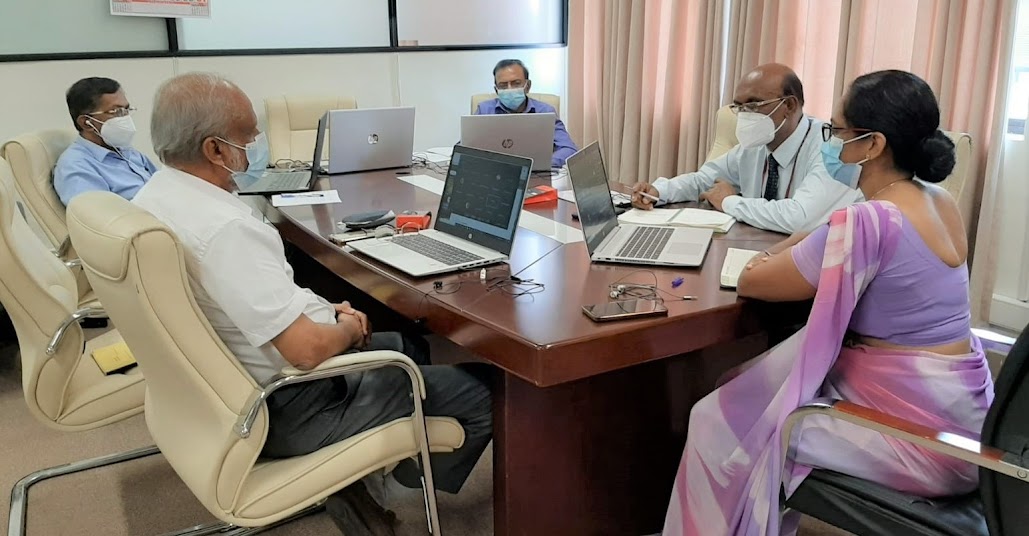
The World Bank team in Sri Lanka has advised the Climate-Smart Irrigated Agriculture Project (CSIAP) to accelerate its activities in 11 identified hotspot districts to effectively achieve project objectives. The World Bank delegation, led by Mr. S. Manoharan, Task Team Leader (TTL) of CSIAP, emphasised that the project’s interventions are playing a critical role in advancing Sri Lanka’s agriculture and irrigation sectors. Mr. Manoharan urged CSIAP officials to take all necessary measures to expedite project implementation in the targeted areas, noting that the project’s active engagement will directly contribute to national development. The advisory session was held today (30th) at the Project Management Unit (PMU), CSIAP, Colombo. The meeting was attended by Eng. R.M.B. Rajakaruna, Project Director, CSIAP, along with senior officials from both the World Bank and the CSIAP.

The CSIAP came to this decision at a special meeting with Mr. P.B.M. Sirisena, Chief Secretary, North Western Province (NWP) held at the Chief Secretary Office, NWP recently. The CSIAP is moving forward in the NWP with the fullest cooperation of government officials.
Mr. J. S. Jayatissa, Director, Provincial Department of Irrigation, Eng. R.M.B. Rajakaruna, Project Director, Mr. O. P. Kithsiri, Deputy Project Director (NWP) and senior officials of the CSIAP attended this meeting.
