Dr. Athula Senaratne (Senior Agriculture Specialist), Mr. Seenithamby Manoharan (Consultant - Agriculture & Rural Development), Mr. Sarath Wickramaratne (Consultant - Institutions) and Mr. Mohamed Ameen (Consultant - Capacity Building, Fiduciary) of the World Bank and Mr. Dinesh Kumar Manhachery (Hydrologist, Food and Agriculture Organization (FAO) of the United Nations Consultant), Professor Rathinasamy Saleth (Climate Smart Agriculture, Producer Collectives & Enterprise Promotion, FAO Consultant); Professor Ravichandran Kannan (CSA Specialist, FAO Consultant), Mr. Azhar Khan (M&E Specialist, FAO Consultant), Senior Officials of Provincial Council and implementing agencies in EP, Eng. R.M.B. Rajakaruna (Project Director), Dr. R.M. Ariyadasa, (Deputy Project Director-EP), Specialists and Officers of the CSIAP were present in this event. Please click Images to see more photos of the MTR of the EP.
Wednesday, 30 March 2022
The WB Officials discuss the MTR of the CSIAP with the Chief Secretary of EP
Tuesday, 29 March 2022
The WB Officials meet the Chief Secretary of NWP on the MTR of the CSIAP
Mr. Sarath Wickramaratne (Consultant - Institutions), Mr. Mohamed Ameen (Consultant - Capacity Building, Fiduciary) and Ms. Anjali Vitharanage (Procurement Specialist)of the World Bank, Mr. Azhar Khan (M&E Specialist, Food and Agriculture Organization (FAO) of the United Nations Consultant), Senior Officials of Provincial Council and implementing agencies in NWP, Eng. R.M.B. Rajakaruna (Project Director), Mr. W.M.S. Wijesinghe, (Acting Deputy Project Director-NWP), Specialists and Officers of the CSIAP attended this event. Please click Images to see more photos of the MTRof the NWP.
Wednesday, 23 March 2022
The Mid Term Review of the CSIAP commences at HARTI, Sri Lanka
The Mid Term Review (MTR) of the Climate Smart Irrigated Agriculture Project (CSIAP) commenced this morning (23rd) at the Hector Kobbekaduwa Agrarian Research and Training Institute (HARTI), Colombo.
The purpose of this Mid Term Review is to assess the continued relevance of the CSIAP’s development objectives, review implementation progress in achieving the goals, assess adequacy of the implementation arrangements in terms of remaining time frame, assess the overall implementation risks, review fiduciary and safeguard compliances, and agree on changes needed in the Financing Agreement to complete the project as agreed.
Mr. John C. Keyser (Senior Agriculture Economist, Task Team Leader of the CSIAP), Dr. Athula Senaratne (Senior Agriculture Specialist), Mr. Seenithamby Manoharan (Consultant - Agriculture & Rural Development), Mr. Sarath Wickramaratne (Consultant - Institutions), Mr. Mohamed Ameen (Consultant - Capacity Building, Fiduciary), Ms. Nadeera Rajapakse (Environmental Specialist), Ms. Sithara Athapatthu (Safeguard Team) and Ms. Samanmalee De Alwis (Program Assistant) of the World Bank, Mr. Dinesh Kumar Manhachery (Hydrologist/Consultant), Professor Ravichandran Kannan (CSA Specialist) of Food and Agriculture Organization of the United Nations, Eng. R.M.B. Rajakaruna (Project Director), Specialists and Officers of the CSIAP attended this event. Please click Images to see more photos of the MTR.
Tuesday, 15 March 2022
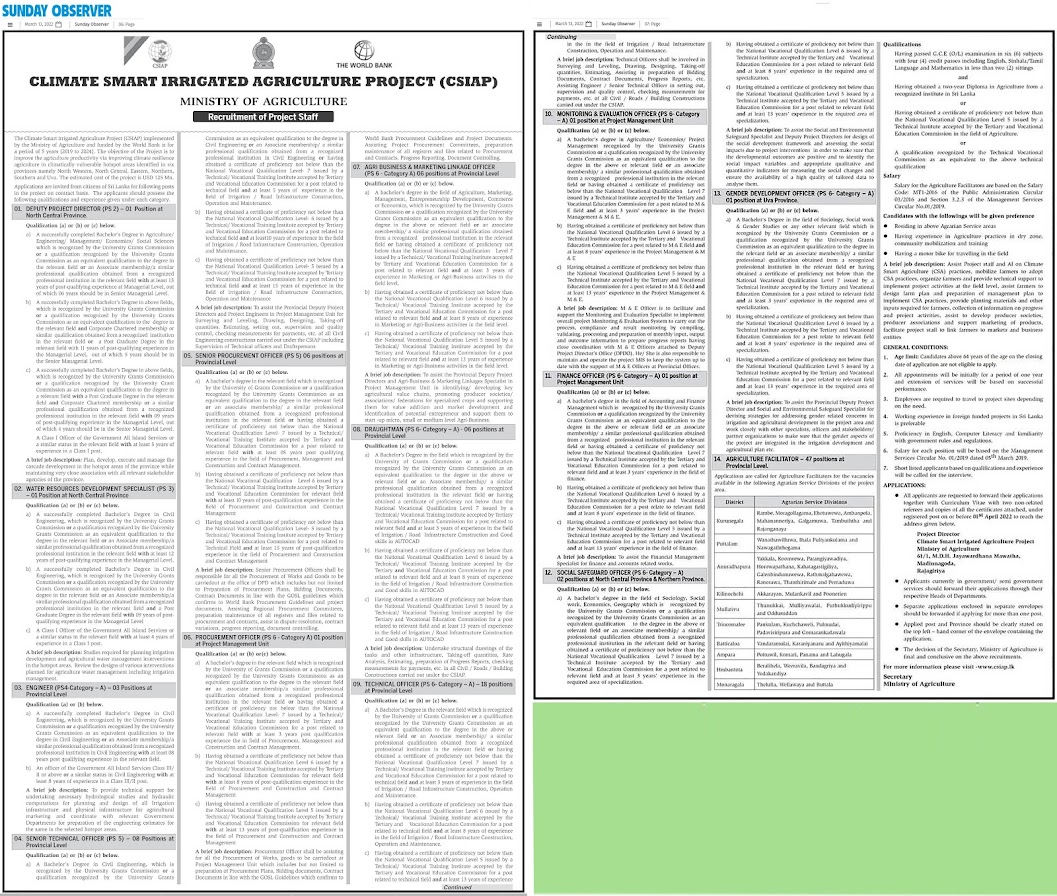
Calling qualified applicants for 102 vacancies at the CSIAP
The Climate Smart Irrigated Agriculture Project (CSIAP) is calling qualified candidates for vacancies below advertised in Sunday Observer published on 13th this month.
Deputy Project Director - 01 Position (North Central Province), Water Resources Development Specialist - 01 Position (North Central Province, Engineer - 03 Positions (Provincial Level), Senior Technical Officer- 08 Positions (Provincial Level), Senior Procurement Officer - 06 Positions (Provincial Level), Procurement Officer - 01 Position (Project Management Unit), Agri-Business & Marketing Linkage Officer - 06 Positions (Provincial Level), Draughtsman - 06 Positions (Provincial Level), Technical Officers - 18 Positions (Provincial Level), Monitoring & Evaluation Officer - 01 Position (Project Management Unit), Finance Officer - 01 Position (Project Management Unit), Social Safeguard Officer - 02 Position (North Central Province/Northern Province), Gender Development Officer - 01 Position (Uva Province) and Agriculture Facilitator - 47 Positions (Provincial Level).
Please visit https://csiap.lk/vacancies for further information
Friday, 11 March 2022
The CSIAP Unveils Its Digitalisation Strategy to Support Farmers in Hotspot Areas
| IEC & ICT Specialist Mr. Mallawaarachchi explaining the CSIAP's Digitalization Strategy |
The The Climate Smart Irrigated Agriculture Project (CSIAP) unveiled its Digitalisation Strategy aimed at strengthening farmer support services in climate hotspot areas. The strategy was presented at the Agri Tech Vendor Forum, organized by the Information and Communication Technology Agency of Sri Lanka (ICTA) in collaboration with the Bill & Melinda Gates Foundation (BMGF), held yesterday (10th). The initiative focuses on establishing fully equipped ICT units within two Agrarian Service Centres (ASCs) located in Parangiyawadiya, Anuradhapura District, and Weerawila, Hambantota District, staffed with trained officials and modern equipment.
Pilot
Implementation in Two Hotspot Areas
As
a pilot intervention, the CSIAP plans to implement the Digitalisation Strategy
in two out of 47 ASCs, covering two identified hotspot areas during this year.
Based on lessons learned from the pilot phase, the project intends to gradually
expand the initiative to all ASCs across 11 hotspot areas during the CSIAP
implementation period. This phased approach aims to transform ASCs into effective
One-Stop Service Centres that deliver timely, technology-driven solutions to
farmers.
Enhancing
Farmer Access to Critical Information
The
Department of Agrarian Development, in collaboration with CSIAP, will implement
the ASC Digitalisation initiative to improve service delivery to farming
communities within the project command areas. Through this system, farmers will
gain access to critical and time-sensitive information, including weather
forecasts, crop production technologies, market prices, marketing
opportunities, disaster and early warning alerts, and other data essential for
safeguarding farm productivity and incomes.
Digital
Tools and Platforms at ASCs
Presenting
the implementation framework, Mr. Samantha Mallawaarachchi, IEC & ICT
Specialist of CSIAP, explained that the digitalized ASCs will be equipped with
a web-based communication system for market and weather information, emergency
alerts, e-governance data, and agriculture-related knowledge. In addition, an Online
Market Place (OMP) will enable farmers to sell agricultural products digitally.
The centres will also feature interactive digital smart boards, wireless
portable sound systems, desktop computers, and kiosk machines that allow users
to access services such as utility payments, loan repayments, credit card
transactions, and insurance services.
Multi-Stakeholder
Collaboration and Leadership
The
forum highlighted strong multi-stakeholder collaboration, with BMGF emphasizing
its commitment to supporting Sri Lanka in developing Farmer Data Management
Systems and digital strategies to address climate change impacts. The
initiative will be driven by ICTA, which organized the forum in Colombo
alongside BMGF. Participants included Mr. Siddharth Chaturvedi representing
BMGF, senior private sector representatives, and ICTA officials led by Mr.
Oshada Senanayake, Chairman of ICTA, reflecting a shared commitment to
advancing digital agriculture in Sri Lanka. Please click Images to see more photos of this programme.
Tuesday, 8 March 2022
Empowering Women on Household Food Security and Rural Resilience
Unique Home Garden Programme - A case study from Sri Lanka
The empowerment of female farmers and female-headed households remains a key project development objective of the Climate Smart Irrigated Agriculture Project (CSIAP). The ongoing CSIAP since 2019 has not only mandated 50% of beneficiaries in all its programmes to be females but also designed and implemented an exclusively women-centric programme aiming to create Climate-Smart Nutritional Sensitive Home Gardens (CSNSHG) across 11 economically and climatically vulnerable districts in Sri Lanka.
The CSIAP has helped to create 4,230 home gardens so far - 2695 in
2020, and 1535 in 2021. Being part of the homesteads, these gardens are small
in size, usually about 0.10 ha (or 0.25 ac). But the combined area of all home
gardens established so far is about 398 ha. Under CSNSHG, beneficiaries are
provided with seeds, planting materials, water-saving equipment, training and
knowledge transfer, and extension support free of charge. Exposure visits are
also arranged to facilitate experience sharing and learning across regions. In
view of its crucial role in household food, nutritional security, cost-cutting
and income addition, CSNSHG has an excellent reception among women across
project regions, so much so that it is one of the most popular and
impact-oriented programmes of CSIAP.
In terms of sustainability, CSNSHGs are designed to support
each family with only a one-time investment and related support, but having
gained knowledge and realized benefits, more than 90% of families have reported
continuing with their home gardens even after the programme.
While the economic and food security impacts of CSNSHG have a powerful empowering role, equally, if not more, the subtle but real impacts on rural women in terms of self-reliance, organizational inclusiveness, sense of solidarity, leadership skills, and time reallocation from routine chores towards more productive and fulfilling activities are important. The formation of women producer societies, training and skill development programmes, and group exposure visits have also created such impacts. These impacts were observed during field visits. It is also observed that homestead vegetable production fits well to women’s livelihood strategies and time and resource availability.
In addition, CSNSHG has also created new knowledge and skills in applying climate-smart agriculture (CSA) technologies, organic fertilizers developed from composted household wastes, and integrated farming systems on a small scale at the homestead level. Since women have learned to produce seeds and planting materials for the next season, the cost on them has been reduced thereby improving the chance of continuity of home gardens. There are also significant spill-over effects on their children as they develop new knowledge on food security, nutrition, and health while they observe their home garden. From a larger perspective, home gardens are one of the key mechanisms for ensuring economic and climate resilience at the local and household level.
Overall, CSNSHG programme and CSIAP, in general, have
contributed significantly not only to the economic and food security dimensions
but also to the social and human development of women empowerment in rural Sri
Lanka. Such contributions have advanced various SDGs both directly and
indirectly. While the contributions are more direct to SDG 5 (Gender Equality),
they occur essentially via their impacts on SDG 1 (No Poverty), SDG 3 (Good
Health and Well-being), SDG 12 (Responsible Consumption and Production), and
SDG 13 (Climate Action).
On this International Women’s Day, it is worthwhile to record, share, and disseminate such positive evidence of women empowerment occurring at the grassroots level of countries such as Sri Lanka. Hope more such local and international evidence of this nature would flow in coming years!
By Ms. Sharmila Shanmuganathan, Gender Development Officer, Project Management Unit, CSIAP